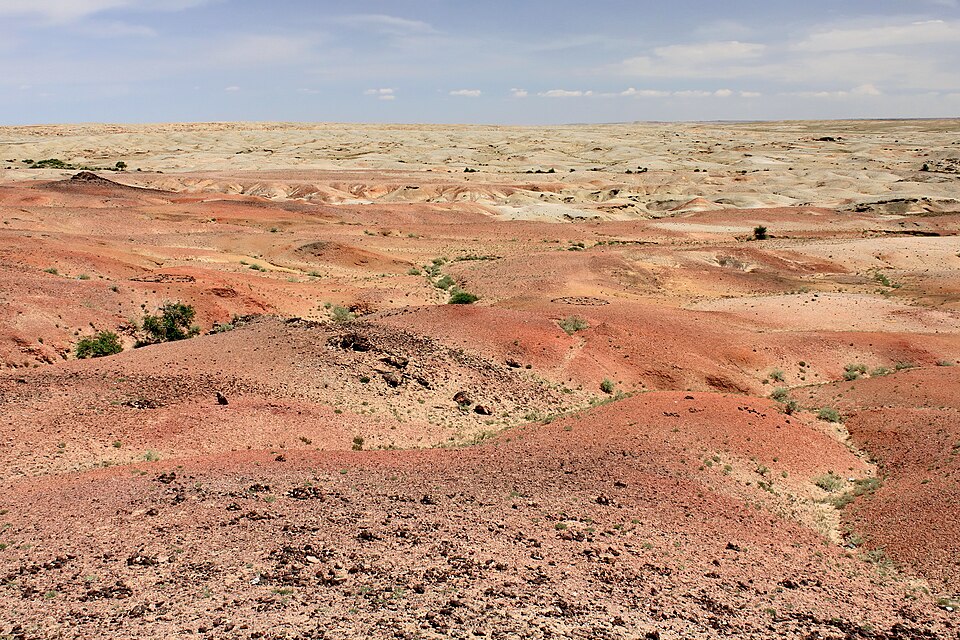
A Desert of Rock, Not Sand
When most people picture a desert, they imagine endless rolling sand dunes, but the Gobi is quite different. Most of the Gobi is covered in bare rock and hard-packed gravel rather than sand. Only about five percent of the desert consists of sand dunes. The landscape includes broad, flat plains called steppes, rocky mountain outcrops, and dry riverbeds that only carry water after rare rainstorms. This rocky terrain gives the Gobi a stark and dramatic appearance unlike the sandy deserts of the Sahara.
Extreme Temperatures
The Gobi is known for some of the most extreme temperature swings of any desert on Earth. During summer, temperatures can soar to 45 degrees Celsius (113 degrees Fahrenheit) under the blazing sun. In winter, the same areas can plunge to minus 40 degrees Celsius (minus 40 degrees Fahrenheit), with biting winds sweeping down from Siberia. These wild swings happen because the Gobi sits on a high plateau, far from any ocean that could moderate the climate. Snow and frost are common in winter, making the Gobi one of the few deserts where you can find ice and snow on the ground.
Wildlife of the Gobi
Despite its harsh conditions, the Gobi supports a surprising variety of animals adapted to extreme heat and cold. The Bactrian camel, recognizable by its two humps, is native to the Gobi and is critically endangered in the wild, with fewer than 1,000 remaining. Snow leopards prowl the rocky mountains along the desert’s edges, hunting ibex and wild sheep. Gobi bears, one of the rarest bears on Earth, survive in small numbers in the desert’s most remote corners. Mongolian wild asses called khulans roam the open plains in herds, and jerboas — tiny hopping rodents — emerge at night to search for seeds and insects.
Dinosaur Discoveries
The Gobi Desert is one of the most important places in the world for dinosaur fossils. In the 1920s, expeditions led by American explorer Roy Chapman Andrews discovered the first known nests of dinosaur eggs in the Gobi, changing scientists’ understanding of how dinosaurs reproduced. The Flaming Cliffs, known locally as Bayanzag, are dramatic red sandstone formations where many of these early discoveries were made. Fossils of Velociraptor and Protoceratops have been found locked together in combat, preserved by a sudden sandstorm millions of years ago. Scientists continue to make new discoveries in the Gobi today, uncovering species that help piece together the story of life on Earth.
The Silk Road
For centuries, the Gobi Desert was a major obstacle — and a key passage — along the ancient Silk Road trade routes that connected China to Central Asia, the Middle East, and Europe. Traders carrying silk, spices, and precious goods had to cross the Gobi’s punishing terrain, relying on oases for water and rest. Camel caravans were the main form of transportation, with Bactrian camels perfectly suited to the desert’s rocky ground and harsh climate. The Silk Road brought not only trade goods but also ideas, religions, and cultures across vast distances, shaping the history of entire civilizations.
People of the Gobi
Nomadic herders have lived in and around the Gobi for thousands of years, moving with the seasons to find water and grazing land for their livestock. Many Mongolian families still live in traditional felt tents called gers (also known as yurts), which can be packed up and moved as needed. Their herds include goats, sheep, horses, and camels, all of which are adapted to the region’s tough conditions. Cashmere wool, which comes from Gobi-region goats, is one of the softest and most valuable fibers in the world and provides an important source of income for herding families.
Conservation Challenges
The Gobi faces growing environmental pressures in the modern era. Overgrazing by livestock is stripping vegetation from fragile desert soils, leading to desertification — the process of once-productive land turning into barren desert. Mining operations for copper, gold, and coal are expanding across the region, disturbing wildlife habitats and water sources. Climate change is making droughts more frequent and severe, threatening both wildlife and the nomadic communities that depend on the land. Conservation groups are working with local governments to protect endangered species like the Bactrian camel and Gobi bear, and to balance economic development with preserving this ancient landscape.
 OtterKnow Kids Encyclopedia