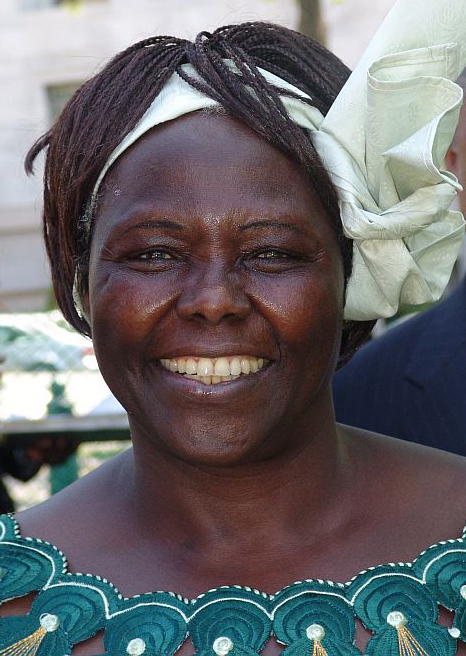
Education and Achievements
Wangari won a scholarship through a program sponsored by President John F. Kennedy that brought hundreds of young Kenyans to study at American universities. She earned a bachelor’s degree in biology from Mount St. Scholastica College in Kansas in 1964 and a master’s degree from the University of Pittsburgh in 1966. She then returned to Kenya and continued her studies at the University of Nairobi, where she earned her PhD in veterinary anatomy in 1971. This made her the first woman in East and Central Africa to earn a doctoral degree. She went on to become the first woman to chair a university department in Kenya, breaking barriers that had kept women out of academic leadership.
Seeing the Problem
When Wangari returned to Kenya after studying in the United States, she was shocked by what she saw happening to the land she loved. Forests were being cut down at an alarming rate to make room for commercial farms growing crops like tea and coffee for export. Without trees to hold the soil in place, the rich topsoil was washing away in the rain, streams were drying up, and the land was becoming barren. Rural women, who depended on forests for firewood, clean water, and food, were walking farther and farther each day to find these basic necessities. Wangari realized that the destruction of forests was not just an environmental problem — it was a human rights problem that hit women and children the hardest.
The Green Belt Movement
In 1977, Wangari founded the Green Belt Movement, an organization that took a simple but powerful approach to solving environmental problems: plant trees. She mobilized thousands of rural Kenyan women, teaching them to collect seeds from local trees, grow seedlings in small nurseries, and plant them in “green belts” across the landscape. The women were paid a small amount for every seedling that survived, giving them both income and a reason to care for the trees. The movement grew rapidly, spreading across Kenya and eventually to other African countries. By the time of Wangari’s death, the Green Belt Movement had planted more than 51 million trees across Africa.
Standing Up to Power
Wangari’s environmental work brought her into direct conflict with the Kenyan government, which was run by a powerful and often corrupt president named Daniel arap Moi. When the government planned to build a massive 60-story office building in Uhuru Park, one of the few public green spaces in the capital city of Nairobi, Wangari led a fierce campaign to stop it. She was mocked, threatened, and called a “crazy woman” by government officials, but she refused to back down. The international attention she drew to the issue eventually forced the government to abandon the project. She was arrested and beaten by police multiple times for her activism, but each time she returned to her work with even greater determination.
The Nobel Peace Prize
In 2004, Wangari Maathai was awarded the Nobel Peace Prize, becoming the first African woman and the first environmentalist ever to receive the honor. The Nobel Committee praised her for linking environmental conservation, democracy, and human rights, explaining that lasting peace depends on protecting the natural world that sustains us all. In her acceptance speech, Wangari told the story of the hummingbird — a tiny bird that carries drops of water to fight a forest fire while larger animals stand by and watch. She said the hummingbird represents the idea that every person can do something, no matter how small, to make a difference.
Government Service
After decades of fighting against the Kenyan government, Wangari finally had a chance to change it from the inside. In 2002, she was elected to Kenya’s parliament with an overwhelming 98 percent of the vote in her district. She was then appointed Assistant Minister for Environment and Natural Resources, a position she held from 2003 to 2005. In this role, she worked to protect Kenya’s forests, promote sustainable development, and give rural communities a greater voice in environmental decisions. She also continued her international advocacy, speaking at the United Nations and working with organizations around the world to fight deforestation and climate change.
Legacy
Wangari Maathai died on September 25, 2011, of ovarian cancer at the age of 71. The United Nations Environment Programme honored her by declaring her birthday, April 1, as “Wangari Maathai Day,” a day to celebrate environmental action and women’s leadership. The Green Belt Movement she founded continues its work today, empowering women and communities across Africa to restore their environments. Wangari’s life showed that protecting the planet and fighting for justice are deeply connected. She proved that one woman with a handful of seeds and an unbreakable spirit could change the landscape of an entire continent.
 OtterKnow Kids Encyclopedia