Learning to Hunt Fossils
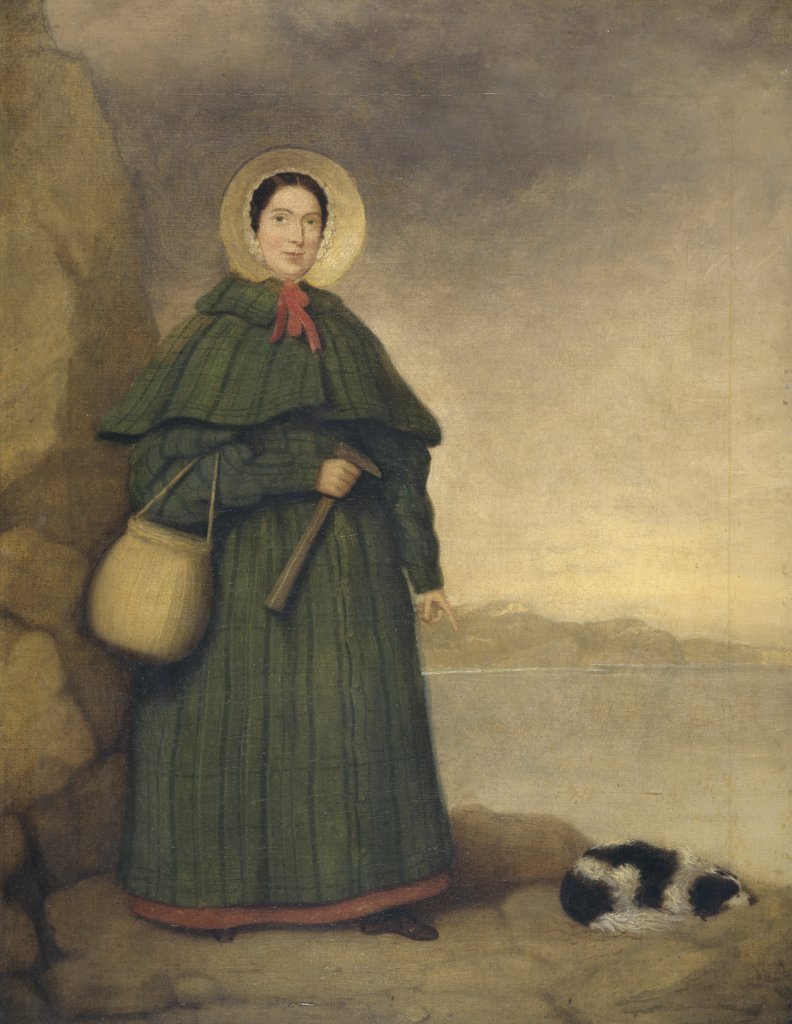
Mary learned to search for fossils by exploring the cliffs and beaches of Lyme Regis with her father and brother. The cliffs along the coast were made of layers of rock from the Jurassic period, around 200 million years old, and were packed with the remains of ancient sea creatures. After heavy rains and storms, chunks of cliff would crumble and fall to the beach, revealing new fossils hidden inside. It was dangerous work because landslides could happen at any moment, and Mary had to time her collecting with the tides. When Mary’s father died in 1810, the family was left in debt, and selling fossils became their main source of income.
The Ichthyosaur Discovery
In 1811, Mary’s brother Joseph spotted an unusual skull sticking out of a cliff near Lyme Regis. Over the following months, 12-year-old Mary carefully excavated the rest of the skeleton, revealing a complete ichthyosaur, a fish-like marine reptile that had lived about 200 million years ago. The skeleton was about 17 feet long and unlike anything scientists had ever seen before. It was the first complete ichthyosaur skeleton ever found, and it caused great excitement in the scientific world. The fossil was eventually purchased by a wealthy collector and made its way to the British Museum, where it amazed visitors.
More Amazing Discoveries
Mary Anning went on to make even more important finds along the Jurassic Coast. In 1823, she discovered the first complete skeleton of a plesiosaur, a long-necked marine reptile with paddle-like flippers that swam in prehistoric seas. The find was so unusual that some scientists at first accused her of faking it, but closer examination proved it was real. In 1828, she found the first pterosaur skeleton ever discovered in Britain, a flying reptile that soared over the oceans millions of years ago. She also discovered important fossil fish and was the first to recognize that certain stone-like objects called bezoar stones were actually fossilized dinosaur droppings, which scientists now call coprolites.
Self-Taught Scientist
Despite never attending school beyond basic reading and writing, Mary Anning became one of the most knowledgeable fossil experts of her time. She taught herself anatomy by dissecting modern fish and squid so she could better understand the ancient creatures she found. She read scientific papers and journals, carefully copying out passages and illustrations to build her knowledge. Mary also became a skilled scientific illustrator, creating detailed drawings of her fossil finds that helped scientists in London and Paris study them. Her understanding of geology and prehistoric life was so deep that visiting scientists would seek her out for guidance when they came to Lyme Regis.
Fighting for Recognition
Even though Mary Anning made some of the most important fossil discoveries of the 1800s, she was often denied credit for her work. As a woman from the working class, she was not allowed to join scientific societies or publish papers in scientific journals. Male scientists who bought her fossils frequently published the findings under their own names without mentioning Mary at all. She once wrote in a letter that the world had used her and was not always kind to her in return. Despite the unfairness she faced, Mary kept working and continued to make discoveries that changed how people understood the history of life on Earth.
Changing How People Thought
Mary Anning’s discoveries helped reshape scientific thinking in profound ways. Before her finds, most people believed that no species had ever gone extinct, because they thought a perfect Creator would not allow any creature to disappear. The strange skeletons Mary unearthed proved that entire groups of animals had once lived on Earth and were now gone forever. Her fossils provided key evidence for the emerging theory of extinction and helped scientists begin to piece together the history of life over millions of years. Although Charles Darwin would not publish his theory of evolution until after her death, Mary’s work laid important groundwork for understanding how life on Earth has changed over time.
Legacy
Mary Anning died of breast cancer on February 9, 1847, at just 47 years old. The famous tongue twister “She sells seashells by the seashore” is believed to have been inspired by her life of collecting and selling fossils on the beach. In 2010, the Royal Society named her one of the ten British women who have most influenced the history of science. A statue of Mary, holding her fossil hammer and accompanied by her dog Tray, was unveiled in Lyme Regis in 2022. Today, the stretch of coast where she hunted for fossils is a UNESCO World Heritage Site known as the Jurassic Coast, and visitors from around the world come to walk the same beaches where Mary made her famous discoveries.
 OtterKnow Kids Encyclopedia