Journey to Africa
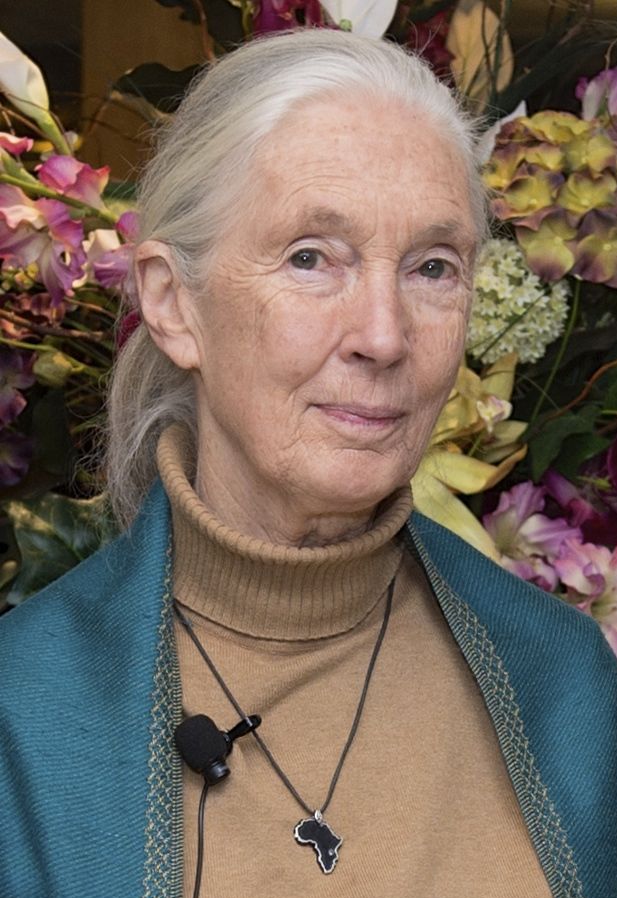
As a young woman, Jane dreamed of living among wild animals in Africa. In 1957, she traveled to Kenya, where she met the famous anthropologist Louis Leakey, who hired her as his assistant. Leakey believed Jane’s patience and open mind made her the perfect person to study wild chimpanzees. In 1960, at just 26 years old, Jane arrived at the Gombe Stream Reserve in Tanzania with no college degree, only a high school diploma. At the time, it was almost unheard of for someone without scientific training to lead a major research project.
One of Jane’s most groundbreaking discoveries came when she watched a chimpanzee she named David Greybeard strip leaves off a twig and poke it into a termite mound to fish out insects to eat. This was the first time anyone had observed a non-human animal making and using a tool. Scientists had long believed that only humans used tools, so Jane’s finding changed the way we define what makes humans unique. When she reported her discovery, Louis Leakey famously said that scientists must now redefine “tool,” redefine “man,” or accept chimpanzees as human.
Changing What We Know About Chimps
Jane also discovered that chimpanzees eat meat, overturning the widely held belief that they were purely vegetarian. She observed chimps hunting smaller monkeys and sharing the meat with other members of their group. Jane saw that chimpanzees have complex social lives, forming friendships, showing affection with hugs and kisses, and sometimes engaging in conflict. Her long-term observations revealed that each chimpanzee has its own distinct personality, emotions, and family bonds, much like humans.
Education and Recognition
Despite never earning a bachelor’s degree, Jane was accepted into a PhD program at the University of Cambridge in 1962, one of very few people in history to do so. She completed her doctorate in ethology, the study of animal behavior, in 1965. Her thesis on the chimpanzees of Gombe was based on years of careful field observations. Jane’s unconventional path proved that dedication and firsthand experience could be just as valuable as traditional academic training.
Conservation Work
In 1977, Jane founded the Jane Goodall Institute to support wildlife research, conservation, and community development in Africa. She also started the Roots & Shoots program in 1991, a youth-led environmental and humanitarian initiative that now operates in over 60 countries. Jane realized that protecting chimpanzees also meant helping the people who lived near their habitats. She became a tireless advocate for sustainable living, traveling nearly 300 days a year to speak about conservation.
Awards and Honors
Jane Goodall’s contributions have earned her many of the world’s highest honors. In 2002, she was named a United Nations Messenger of Peace. She has received the Medal of Tanzania, France’s Legion of Honour, and Japan’s prestigious Kyoto Prize. In 2004, she was named a Dame Commander of the Order of the British Empire by Queen Elizabeth II. Jane has written dozens of books for adults and children, sharing her love of chimpanzees and nature with millions of readers around the world.
Why Jane Goodall Matters
Jane Goodall has spent more than 60 years studying, protecting, and advocating for chimpanzees and their habitats. Her discoveries about tool use and social behavior forever changed how scientists understand animals and their relationship to humans. By founding Roots & Shoots, she empowered young people on every continent to take action for the environment. Jane showed that one person with passion, patience, and courage can reshape how we understand nature and motivate millions of people to protect it.
 OtterKnow Kids Encyclopedia