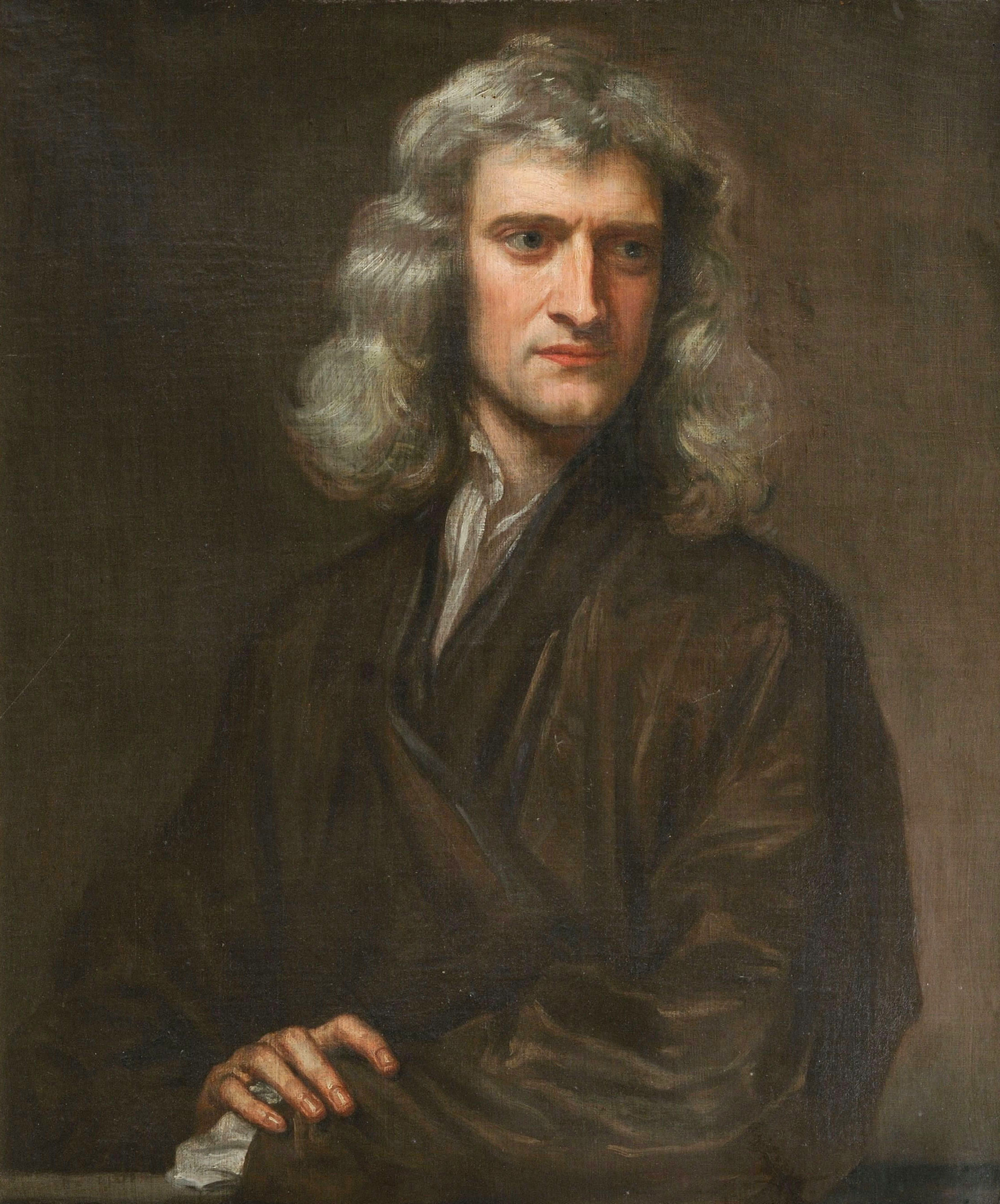
Growing Up and Education
As a boy, Newton was curious and loved building mechanical gadgets like sundials and model windmills. He attended the King’s School in Grantham, where he was not always the top student at first but eventually rose to the head of his class. In 1661, he entered Trinity College at the University of Cambridge, where he studied mathematics, philosophy, and the ideas of ancient Greek thinkers. When the Great Plague forced Cambridge to close in 1665, Newton returned home and began making one discovery after another.
The Laws of Motion
In 1687, Newton published his masterpiece, a book called Principia Mathematica, which is considered one of the most important scientific books ever written. In it, he described three laws of motion that explain how objects move. The first law says an object stays still or keeps moving unless a force acts on it. The second law explains that force equals mass times acceleration, and the third law states that every action has an equal and opposite reaction. These three laws became the foundation of physics for over two hundred years.
The Law of Gravity
Newton formulated the law of universal gravitation, which says that every object with mass attracts every other object with mass. According to a famous legend, Newton was inspired when he watched an apple fall from a tree in his mother’s garden. He realized the same force that pulled the apple to the ground also kept the Moon orbiting Earth. His law of gravity explained everything from why things fall to how planets move around the Sun, connecting the heavens and Earth with one elegant idea.
Light and Color
In 1666, Newton conducted a groundbreaking experiment with light. He darkened his room and let a thin beam of sunlight pass through a glass prism, which split the white light into all the colors of the rainbow. Newton showed that white light is actually a mixture of red, orange, yellow, green, blue, and violet light. This discovery changed how scientists understood light and color. He published his findings in a book called Opticks in 1704.
Inventions and Mathematics
Newton built the first practical reflecting telescope in 1668, using curved mirrors instead of glass lenses to see distant objects more clearly. His design, called the Newtonian telescope, is still used by astronomers today. Newton also invented an entirely new branch of mathematics called calculus, which is used to study how things change. A German mathematician named Gottfried Leibniz developed calculus independently around the same time, and the two men had a famous and bitter argument over who deserved the credit.
Later Life and Legacy
In his later years, Newton served as Warden and then Master of the Royal Mint, where he helped reform England’s currency. He was elected president of the Royal Society in 1703 and was knighted by Queen Anne in 1705, becoming Sir Isaac Newton. He died on March 31, 1727, at the age of 84 and was buried in Westminster Abbey among kings and queens. Albert Einstein, another legendary physicist, kept a portrait of Newton on his study wall, showing just how deeply Newton’s work influenced science for centuries to come.
Why Isaac Newton Matters
Newton’s discoveries laid the groundwork for modern physics, astronomy, and mathematics. His laws of motion and gravity allowed scientists to predict the orbits of planets, design bridges, and eventually send rockets into space. He showed that the universe follows rules that can be understood through observation and mathematics. Newton once said he had seen further by “standing on the shoulders of giants,” but he himself became one of the tallest giants in the history of science.
 OtterKnow Kids Encyclopedia