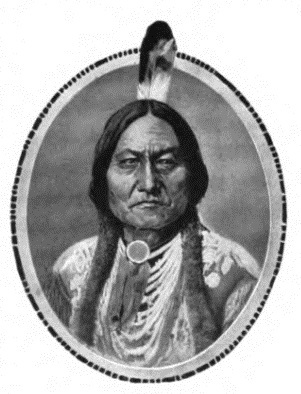
Becoming a Warrior
When Jumping Badger was about 14 years old, he joined his first battle and showed remarkable bravery. After that fight, his father honored him with the name Tȟatȟáŋka Íyotake, which means “Sitting Bull” in the Lakota language. The name described a powerful buffalo bull that plants itself firmly and refuses to back down. As a young man, Sitting Bull earned a reputation as one of the fiercest and most courageous warriors among the Lakota people. He counted coup, which meant touching an enemy in battle without harming them — one of the highest honors a warrior could earn.
A Leader of His People
Sitting Bull grew to become much more than a warrior. He was also a holy man, or spiritual leader, who performed sacred ceremonies and offered guidance to his people. By the 1860s, he had risen to become the principal chief of the entire Lakota Sioux nation, a rare honor that united many different bands under one leader. He used his position to bring together not only the Lakota but also the Cheyenne and Arapaho peoples to resist the United States government’s attempts to take their land. Sitting Bull believed deeply that the Black Hills and the Great Plains belonged to his people, and he refused to sign treaties giving that land away.
The Vision Before Battle
In June 1876, Sitting Bull performed a sacred Sun Dance ceremony that lasted for days. During the ceremony, he had a powerful vision in which he saw American soldiers falling from the sky “like grasshoppers” into his camp. He told his people that this vision meant they would win a great victory against the soldiers who were coming to force them onto reservations. His followers took heart from this prophecy and prepared themselves for the coming fight. The vision gave the warriors tremendous confidence that the spirits were on their side.
The Battle of the Little Bighorn
On June 25 and 26, 1876, Sitting Bull’s vision came true at the Battle of the Little Bighorn in present-day Montana. Lieutenant Colonel George Armstrong Custer led about 210 soldiers of the 7th Cavalry against a massive camp of Lakota and Cheyenne warriors. The Native American force, numbering perhaps 2,000 warriors, overwhelmed Custer’s troops and defeated them completely. Custer and all of his men in that detachment were killed in what became one of the most famous battles in American history. Although Sitting Bull did not fight directly because of his role as a spiritual leader, his vision and leadership had united the warriors who won the battle.
Life in Exile and Surrender
After the Battle of the Little Bighorn, the U.S. Army sent thousands more soldiers to hunt down Sitting Bull and his followers. Facing starvation as the buffalo herds disappeared, Sitting Bull led his people across the border into Canada in 1877, where they lived for four years. Life in Canada was very difficult because game was scarce and the Canadian government would not provide supplies. In 1881, Sitting Bull finally returned to the United States and surrendered at Fort Buford in present-day North Dakota. He was held as a prisoner of war for nearly two years before being sent to the Standing Rock Reservation.
Buffalo Bill’s Wild West Show
In 1885, Sitting Bull joined Buffalo Bill Cody’s famous Wild West show, a traveling entertainment spectacle that toured across the United States and Europe. He was paid fifty dollars a week and earned extra money by selling autographed photos of himself to curious audience members. Sitting Bull reportedly gave much of the money he earned to homeless and hungry children he met in the cities, saying he could not understand how white people could allow such poverty. He stayed with the show for only one season before returning to his home at Standing Rock. The experience reinforced his belief that life on the plains was far better than life in the crowded American cities.
His Final Stand
In the late 1880s, a spiritual movement called the Ghost Dance spread among Native American communities, promising that the old ways of life would return. The U.S. government feared the movement could lead to an uprising and wanted to arrest leaders who supported it. On December 15, 1890, a group of Indian police officers came to Sitting Bull’s cabin at Standing Rock to arrest him. A struggle broke out, and Sitting Bull was shot and killed at the age of 59. His death shocked Native communities across the country and came just two weeks before the tragic massacre at Wounded Knee.
Sitting Bull’s Legacy
Sitting Bull is remembered today as one of the greatest leaders in Native American history. He spent his entire life fighting to protect the land, culture, and freedom of the Lakota Sioux people against enormous odds. His courage in standing up to the United States government inspired not only his own people but also future generations of Indigenous activists. Monuments, books, and films have honored his memory, and his name remains a powerful symbol of resistance and dignity. Sitting Bull showed the world that true leadership means putting your people’s needs above your own safety and comfort.
 OtterKnow Kids Encyclopedia