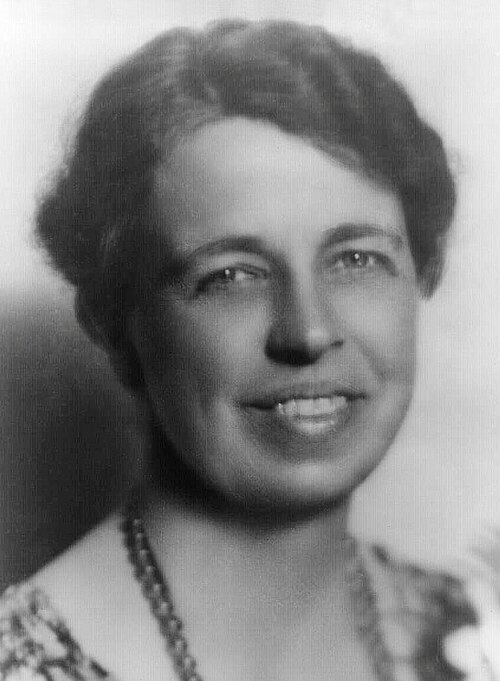
Education and Finding Her Path
At age 15, Eleanor was sent to Allenswood Academy, a boarding school near London, England, where she thrived for the first time in her life. The school’s headmistress, Marie Souvestre, encouraged Eleanor to think independently, speak her mind, and care about social justice. Eleanor later called her years at Allenswood the happiest of her life. When she returned to New York, she began volunteering at settlement houses on the Lower East Side, teaching immigrant children and investigating unsafe factory conditions. These experiences opened her eyes to the poverty and inequality that existed just blocks from her family’s mansion, and they set her on a course she would follow for the rest of her life.
Marriage and the White House
In 1905, Eleanor married her distant cousin Franklin Delano Roosevelt, and together they had six children, one of whom died in infancy. When Franklin was elected the 32nd President of the United States in 1932, Eleanor became First Lady and immediately began transforming the role in ways no one had imagined. She held her own press conferences, something no First Lady had ever done before, and she only invited female reporters so that news organizations would be forced to hire women. She wrote a daily newspaper column called “My Day,” which ran six days a week for nearly 27 years. She also gave radio addresses and traveled constantly, serving as the president’s eyes and ears across the country during the Great Depression and World War II.
Standing Up for Civil Rights
One of Eleanor’s bravest moments came in 1939, when the Daughters of the American Revolution refused to allow the celebrated Black singer Marian Anderson to perform at Constitution Hall in Washington, D.C. Eleanor publicly resigned from the organization in protest, drawing national attention to the injustice. She then helped arrange for Anderson to give a free outdoor concert at the Lincoln Memorial, where an audience of 75,000 people gathered to hear her sing. Throughout her life, Eleanor spoke out against racial segregation, supported anti-lynching legislation, and worked to ensure that Black Americans had equal access to New Deal programs. She formed a close friendship with civil rights leader Mary McLeod Bethune and used her influence to push for change at a time when many powerful people wanted things to stay the same.
Champion of Human Rights Around the World
After President Roosevelt died in 1945, President Harry Truman appointed Eleanor as a United States delegate to the newly formed United Nations. From 1946 to 1948, she chaired the UN Commission on Human Rights, leading the effort to draft the Universal Declaration of Human Rights. This historic document, adopted by the UN General Assembly on December 10, 1948, declared for the first time that all people everywhere are born with fundamental rights and freedoms. Eleanor worked tirelessly to build consensus among delegates from countries with very different cultures, governments, and beliefs. The declaration has been translated into more than 500 languages and remains one of the most important documents in human history.
Writer, Speaker, and Public Voice
Eleanor Roosevelt was one of the most prolific writers and communicators of her era. Her “My Day” newspaper column, which she began in 1935 and continued until shortly before her death, was read by millions of Americans and covered everything from world politics to her daily observations. She wrote multiple books, including her autobiography and works on democracy, citizenship, and human rights. She appeared frequently on radio and later on television, becoming one of the first public figures to use media to connect directly with ordinary people. Her ability to speak honestly and warmly made her one of the most admired women in the world.
Advocating for Women and Workers
Throughout her career, Eleanor fought to improve the lives of women and working people across the United States. She pushed for equal pay, better working conditions, and the right of workers to organize into unions. She supported the creation of programs that helped unemployed women during the Great Depression and advocated for affordable housing and healthcare. Eleanor believed that democracy could only work if every citizen, regardless of gender or economic status, had the opportunity to live with dignity. Her tireless advocacy helped pave the way for many of the workplace protections and civil rights laws that exist today.
Legacy and Lasting Impact
Eleanor Roosevelt died on November 7, 1962, at the age of 78. President Truman had called her the “First Lady of the World,” a title that recognized how far her influence reached beyond the role of a president’s wife. She showed that one person’s courage and compassion could change not just a country but the entire world. Her work on the Universal Declaration of Human Rights created a foundation for international human rights law that continues to protect people today. Eleanor proved that speaking up for others, even when it is unpopular, can lead to real and lasting change.
 OtterKnow Kids Encyclopedia