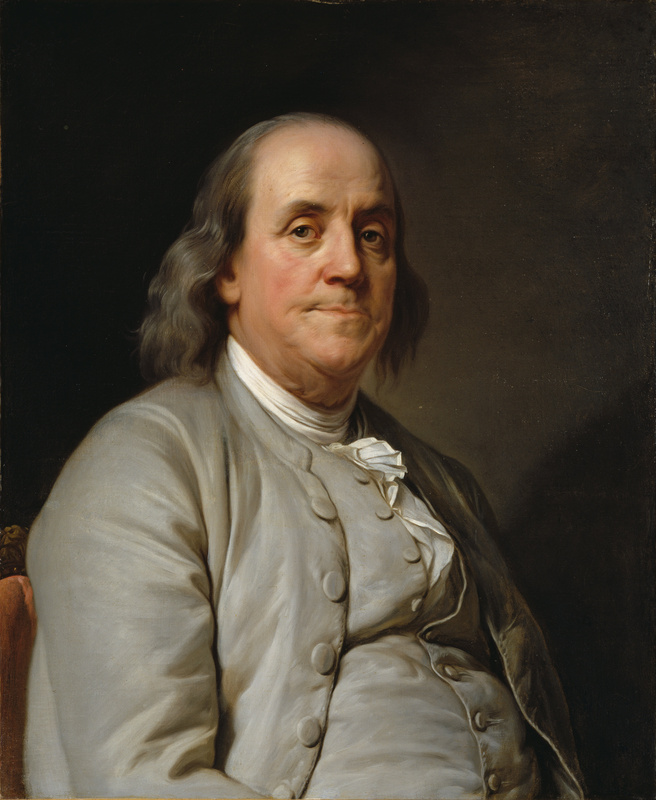
Printer and Writer
At age 17, Franklin ran away to Philadelphia, Pennsylvania, with almost no money in his pocket. He found work in print shops and eventually started his own printing business, which became very successful. In 1732, he began publishing “Poor Richard’s Almanack,” a yearly book filled with weather predictions, recipes, jokes, and wise sayings like “Early to bed and early to rise, makes a man healthy, wealthy, and wise.” The almanack was a bestseller in the American colonies for 25 years. Franklin also founded the Pennsylvania Gazette, one of the most popular newspapers in the colonies.
Inventions
Franklin was a brilliant inventor who never patented any of his creations because he wanted everyone to benefit from them. He invented the lightning rod, which protects buildings from being struck and damaged by lightning during storms. He also created bifocal glasses, which have two different lens strengths in one pair so people can see both near and far. The Franklin stove, another of his inventions, heated rooms more efficiently than a regular fireplace while using less wood. He even invented a flexible urinary catheter to help his brother, who had bladder problems, showing his practical and caring nature.
Scientific Discoveries
Franklin’s most famous experiment took place in 1752, when he flew a kite during a thunderstorm to prove that lightning is a form of electricity. He attached a metal key to the kite string, and when lightning struck nearby, he observed an electrical spark from the key. This dangerous experiment, which could have killed him, proved his theory and led to the invention of the lightning rod. Franklin also studied ocean currents and created one of the first detailed maps of the Gulf Stream. His scientific work earned him honorary degrees from universities in Europe and made him one of the most respected scientists of his time.
Franklin believed strongly in improving the community around him, and he founded many important institutions. In 1731, he helped create the Library Company of Philadelphia, which is considered the first public lending library in America. He organized Philadelphia’s first volunteer fire company, the Union Fire Company, in 1736. Franklin also helped establish the Academy of Philadelphia, which later became the University of Pennsylvania. He started the first hospital in the American colonies, Pennsylvania Hospital, in 1751. He even helped improve Philadelphia’s streets by pushing for paving, cleaning, and lighting them at night.
Founding Father
Benjamin Franklin was one of the most important Founding Fathers of the United States. He was one of five men who helped write the Declaration of Independence, which he signed on August 2, 1776. He is the only Founding Father who signed all four of the major documents that created the nation: the Declaration of Independence, the Treaty of Alliance with France, the Treaty of Paris that ended the Revolutionary War, and the United States Constitution in 1787. During the Constitutional Convention, Franklin, at age 81, was the oldest delegate. His wisdom and humor helped the delegates compromise and create the system of government that Americans still use today.
Diplomat in France
During the American Revolution, Franklin served as the American ambassador to France, arriving in Paris in 1776 at the age of 70. The French people loved him — they admired his scientific achievements and his down-to-earth personality. Franklin worked skillfully to convince the French government to support the American fight for independence. In 1778, he secured a crucial military alliance with France, which provided soldiers, ships, and money that helped America win the war. Without Franklin’s diplomatic success in France, the United States might never have won its independence from Britain.
Later Life and Legacy
Franklin spent his final years in Philadelphia, where he served as president of the Pennsylvania Executive Council and continued to write and invent. He became an outspoken opponent of slavery and served as president of the Pennsylvania Abolition Society. Benjamin Franklin died on April 17, 1790, at the age of 84, and about 20,000 people attended his funeral. Today, his face appears on the $100 bill, making him one of the most recognized figures in American history even though he was never president. His life story — from a poor boy in Boston to one of the most admired people in the world — continues to inspire people who believe in hard work, curiosity, and service to others.
Fun Facts
- Franklin once wrote a letter to a scientific society about the benefits of studying the science of passing gas.
- He loved to swim and even invented hand paddles to help him move faster through water.
- Franklin created one of the first political cartoons in America, a drawing of a snake cut into pieces with the words “Join, or Die.”
- He played three musical instruments: the violin, the harp, and the guitar, and he also invented a musical instrument called the glass armonica.
- At his funeral, the French National Assembly in Paris declared three days of mourning to honor him.
 OtterKnow Kids Encyclopedia