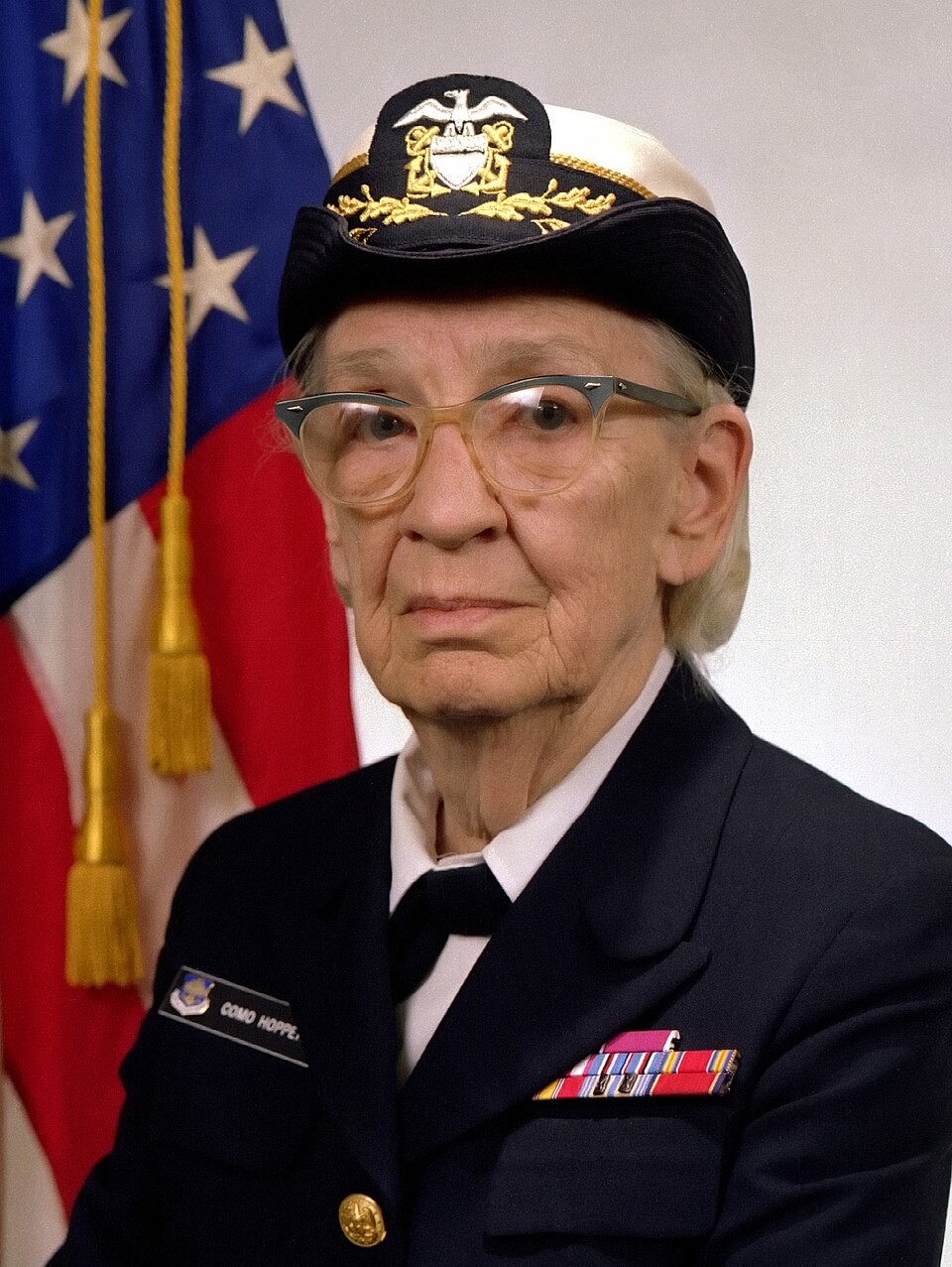
Early Life and Education
As a child, Grace loved taking apart alarm clocks to figure out how they worked. She excelled in school and went on to attend Vassar College, where she earned a degree in mathematics and physics. She then continued her studies at Yale University, where she received a Ph.D. in mathematics in 1934, which was very rare for a woman at that time. After finishing her education, she became a math professor at Vassar and taught for several years before the events of World War II changed her path.
Joining the Navy
When the United States entered World War II, Hopper wanted to serve her country. In 1943, she joined the United States Navy Reserve and was assigned to work on the Mark I computer at Harvard University. The Mark I was one of the first large-scale computers ever built, and it was used to perform important calculations for the war effort. Hopper quickly became an expert at programming it, writing some of the earliest computer programs in history. She loved the work so much that she stayed in the Navy for decades, eventually reaching the rank of Rear Admiral.
The First Compiler
One of Hopper’s greatest achievements was creating the first compiler in 1952. A compiler is a special program that translates instructions written in human-readable words into the machine code that computers understand. Before compilers, programmers had to write instructions using long strings of ones and zeros, which was slow and easy to mess up. Hopper believed that programming should be done in something closer to plain English, and her compiler made that possible. Many people doubted her idea at first, but she proved them wrong.
COBOL and Programming Languages
Hopper went on to lead the team that developed COBOL, which stands for Common Business-Oriented Language. COBOL was one of the first programming languages designed so that people without deep math training could write computer programs. It used words like “ADD,” “MOVE,” and “DISPLAY” that made sense to business professionals. COBOL became one of the most widely used programming languages in the world, and even today it still runs many banking and government computer systems. Hopper’s vision of making computers accessible to everyone was finally becoming real.
Debugging and the Famous Moth
Hopper is often credited with making the term “debugging” popular in computer science. In 1947, while working on the Mark II computer at Harvard, her team found an actual moth stuck in one of the machine’s electrical relays, causing it to malfunction. They taped the moth into the computer’s logbook and wrote “first actual case of bug being found.” Although the word “bug” had been used before to describe technical problems, this real-life moth made the story legendary. The logbook with the moth is now preserved at the Smithsonian Institution’s National Museum of American History.
Personality and Legacy
Hopper was known for her sharp wit, her love of teaching, and her habit of challenging the way things had always been done. She kept a clock on her wall that ran counterclockwise to remind visitors that just because something has always been done one way does not mean it is the best way. In 2016, she was posthumously awarded the Presidential Medal of Freedom, the highest civilian honor in the United States. The U.S. Navy also named a guided-missile destroyer, the USS Hopper, in her honor. Grace Hopper showed the world that curiosity and determination can change the future of technology.
 OtterKnow Kids Encyclopedia