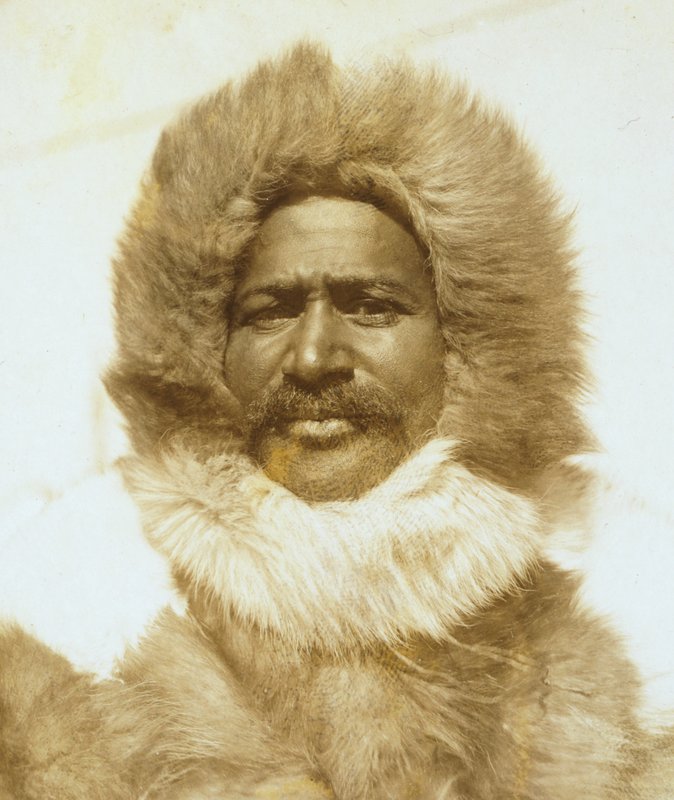
Early Life and Adventures at Sea
Henson had a difficult childhood and was orphaned at a young age. When he was about twelve years old, he walked to Baltimore and found work as a cabin boy on a merchant ship called the Katie Hines. The ship’s captain, Captain Childs, took an interest in young Matthew and taught him to read, write, and navigate. Over the next several years, Henson sailed around the world, visiting ports in Africa, Asia, and Europe. These early experiences at sea gave him the skills and toughness that would later prove essential in the Arctic.
Arctic Expeditions with Robert Peary
In 1887, Henson met Robert Peary while working in a hat shop in Washington, D.C., and Peary hired him as an assistant for a trip to Nicaragua. Impressed by Henson’s abilities, Peary invited him on his Arctic expeditions, and the two men went on eight trips to the Arctic together over the next eighteen years. Henson learned to speak Inuktitut, the language of the Inuit people, and became an expert at driving dog sleds, building igloos, and surviving in extreme cold. The Inuit respected Henson greatly and gave him the name “Mahri-Pahluk,” which means “Matthew the Kind One.” His skills made him absolutely essential to the success of the expeditions.
Reaching the North Pole
On April 6, 1909, after years of failed attempts and brutal hardship, Henson and Peary’s team finally reached the North Pole. Henson actually arrived at the Pole first, stepping onto the spot slightly ahead of Peary, who was traveling on a separate sled. When Peary caught up about forty-five minutes later, Henson greeted him and planted the American flag at what they believed to be the top of the world. The team that made the final push included Henson, Peary, and four Inuit men named Ootah, Egingwah, Seegloo, and Ooqueah. It was one of the most daring and difficult journeys ever attempted, covering hundreds of miles across shifting, cracking sea ice in temperatures far below zero.
A Long Wait for Recognition
When Peary announced the achievement, he received fame and honors, but Henson’s contributions were largely ignored because of the racism of the time. For many years, Henson worked as a clerk at a federal customs house in New York, far from the spotlight. Slowly, recognition began to come. In 1944, Congress awarded Henson a duplicate of the silver medal that Peary had received for the expedition. In 1988, his remains were moved to Arlington National Cemetery, where he was reburied with full military honors near Peary’s grave. Today, Matthew Henson is celebrated as a true American hero who overcame incredible obstacles to achieve something extraordinary.
 OtterKnow Kids Encyclopedia