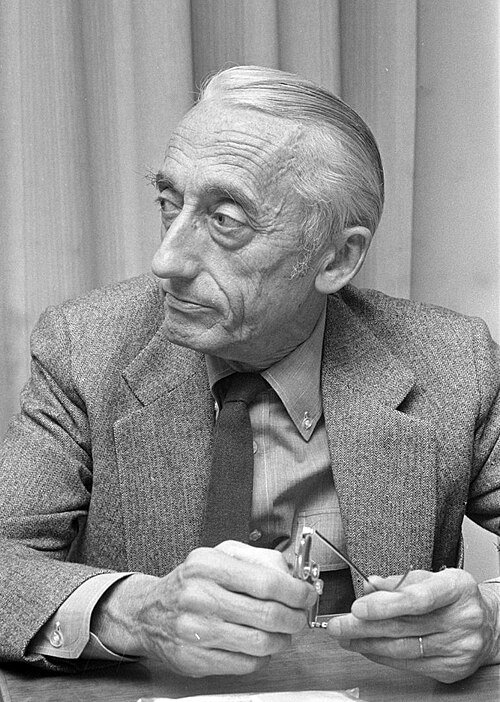
Early Life
As a child, Cousteau was fascinated by water and machines. He loved swimming and even built a small model crane when he was just 11 years old. He joined the French Navy as a young man and trained as a pilot, but a serious car accident ended his flying career. During his recovery, a friend gave him a pair of swimming goggles, and Cousteau was amazed by what he could see beneath the surface of the water. That experience changed his life forever and set him on the path to becoming an ocean explorer.
Inventing the Aqua-Lung
Before Cousteau, divers had to wear heavy helmets connected to air hoses on the surface, which made it hard to move freely underwater. In 1943, Cousteau and French engineer Emile Gagnan developed the Aqua-Lung, a lightweight device that let divers carry their own air supply on their backs. This invention was a breakthrough because it allowed people to swim freely and explore underwater like never before. The Aqua-Lung became the foundation for modern SCUBA diving, which stands for Self-Contained Underwater Breathing Apparatus. Cousteau’s invention opened the ocean to scientists, photographers, and adventurers around the world.
The Calypso and Ocean Exploration
In 1950, Cousteau converted a former military minesweeper into his famous research ship, the Calypso. For decades, the Calypso sailed the world’s oceans while Cousteau and his crew filmed underwater life, explored shipwrecks, and studied marine ecosystems. Cousteau also pioneered underwater filmmaking, developing waterproof cameras and lighting systems to capture stunning images beneath the waves. His 1956 film The Silent World won both the Palme d’Or at the Cannes Film Festival and an Academy Award. He later created the Conshelf underwater habitats, where people actually lived and worked on the ocean floor for weeks at a time.
Television and Fame
In 1968, Cousteau launched his television series The Undersea World of Jacques Cousteau, which ran for nine seasons. The show took viewers on adventures to coral reefs, deep-sea trenches, and remote islands, introducing them to whales, sharks, octopuses, and countless other sea creatures. Cousteau had a gift for storytelling that made science feel like an adventure. His signature red knit cap and calm, curious voice became recognized around the world. The series inspired an entire generation of marine biologists, divers, and ocean lovers.
Ocean Conservation
As Cousteau spent more time in the oceans, he began to see how pollution, overfishing, and habitat destruction were harming marine life. He became one of the earliest public voices warning about the dangers facing the world’s oceans. In 1973, he founded the Cousteau Society, an organization dedicated to protecting ocean ecosystems. He spoke out against dumping nuclear waste in the sea and campaigned to protect Antarctica from mining. Cousteau believed that people would only protect the ocean if they first learned to love it, which is why he worked so hard to share its wonders.
His Legacy
Jacques Cousteau died on June 25, 1997, at the age of 87. He left behind a legacy as one of the most important ocean explorers and conservationists in history. His inventions made it possible for humans to explore the deep sea, and his films and television shows taught the world to care about ocean life. The Cousteau Society continues his work today, and his influence can be seen in every nature documentary and marine conservation effort. Cousteau showed that the ocean is not just a vast empty space but a living world full of wonder that deserves our protection.
 OtterKnow Kids Encyclopedia