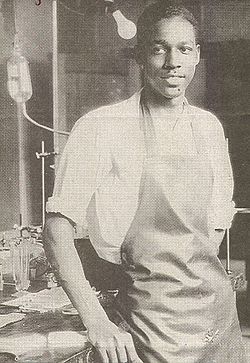
Growing Up and Early Career
Vivien Thomas grew up in Nashville, Tennessee, where his family had moved when he was a toddler. He was an excellent student and saved money from his carpentry jobs to pay for college, planning to become a doctor. When the stock market crashed in 1929 and the Great Depression wiped out his savings, Thomas had to find a different path. In 1930, he took a job as a laboratory assistant for Dr. Alfred Blalock at Vanderbilt University, where he quickly proved himself to be an exceptionally skilled researcher and surgeon.
The Blue Baby Operation
Blue baby syndrome, known medically as Tetralogy of Fallot, is a heart condition that prevents enough oxygen from reaching a baby’s blood, turning their skin blue. In the early 1940s, there was no treatment and many of these babies died. Working alongside Dr. Blalock and cardiologist Dr. Helen Taussig at Johns Hopkins Hospital, Thomas spent years developing and perfecting a surgical technique to fix the problem. On November 29, 1944, the first successful blue baby operation was performed, with Thomas standing behind Blalock in the operating room, guiding him through each step of the procedure they had practiced together.
Overlooked and Underpaid
Despite his critical role in one of the most important medical breakthroughs of the twentieth century, Vivien Thomas did not receive the recognition he deserved for many years. At Johns Hopkins, he was classified as a janitor on the payroll because the hospital did not have a job category for a Black laboratory technician. He was paid far less than white colleagues who had similar or even lesser skills. When Dr. Blalock published the famous paper about the blue baby operation, Thomas was not listed as a co-author, even though he had developed much of the surgical technique himself.
Finally Recognized
Over time, the medical community began to acknowledge the enormous contributions Vivien Thomas had made. In 1976, Johns Hopkins University awarded him an honorary doctorate, and his portrait was hung alongside those of other distinguished faculty members at the university. Thomas also became the first African American to hold the title of Instructor of Surgery at Johns Hopkins. He spent his later years training a new generation of surgeons, many of whom went on to become leaders in heart surgery. Thomas passed away on November 26, 1985.
His Lasting Legacy
Vivien Thomas’s story shows what can happen when skill and persistence meet deep injustice. In 2004, HBO released a film called Something the Lord Made that told the story of Thomas and Blalock, bringing Thomas’s contributions to the attention of millions of people. His life shows how racial discrimination in America kept brilliant people from receiving the credit and opportunities they earned through their hard work. Today, Vivien Thomas is celebrated as a pioneer in cardiac surgery whose hands and mind helped transform modern medicine.
 OtterKnow Kids Encyclopedia