History of Origami
Paper was invented in China around the year 105 CE, and papermaking techniques reached Japan by the 600s. Japanese craftspeople developed a thin, strong paper called washi, and people began folding it into decorations for religious ceremonies and celebrations. During the Edo period (1603 to 1867), paper became cheaper and more widely available, and origami spread from the wealthy nobility to ordinary families. The oldest known origami instruction book, called “Hiden Senbazuru Orikata” (How to Fold a Thousand Cranes), was published in Japan in 1797. In the 1950s, a Japanese artist named Akira Yoshizawa revolutionized origami by inventing a system of written diagrams using dotted lines and arrows that allowed anyone to follow folding instructions. His notation system is still used worldwide today, and he created more than 50,000 original designs during his lifetime.
The Story of Sadako and the Paper Cranes
One of the most moving stories connected to origami is the story of Sadako Sasaki. Sadako was two years old when an atomic bomb was dropped on her city of Hiroshima, Japan, in 1945. When she was twelve, she became very sick with leukemia. A friend told her about a Japanese legend that says anyone who folds one thousand paper cranes will be granted a wish. Sadako began folding cranes from any paper she could find, including medicine wrappers. According to her family, she folded well over one thousand cranes before she passed away in 1955 at age twelve. Today, a statue of Sadako holding a golden crane stands in the Hiroshima Peace Memorial Park, and people from around the world leave paper cranes there as symbols of peace.
Types and Techniques
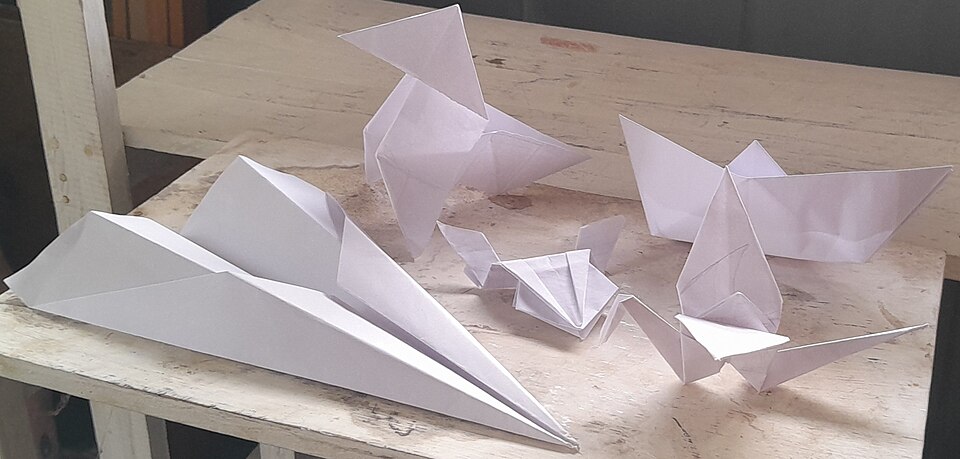
Traditional origami uses a single square sheet of paper with no cuts allowed, but the art form has branched into many styles. Modular origami involves folding multiple identical pieces, called units, and fitting them together to create geometric shapes like stars, cubes, and spheres. Wet-folding is a technique where the paper is slightly dampened so that the finished model has soft, rounded curves instead of sharp creases, making animals look more lifelike. Kirigami is a related art that does allow cuts along with folds and is often used to make pop-up cards and snowflake designs. Action origami creates models that actually move: jumping frogs that leap when you press their backs, flapping birds that move their wings, and spinning tops.
Origami and Science
Origami is not just an art form. It has become an important tool in science, engineering, and mathematics. Engineers at NASA have used origami folding patterns to design solar panels that fold up small enough to fit inside a rocket and then unfold to full size in space. Medical researchers have developed tiny origami-inspired devices that can be swallowed as a small capsule and then unfold inside the body to deliver medicine or perform repairs. Mathematicians study the geometry of paper folding to solve problems that cannot be solved with a ruler and compass alone. Car manufacturers use origami principles to design airbags that fold flat and deploy quickly in a crash. The ancient art of paper folding continues to inspire new technology in surprising ways.
How to Get Started
All you need to begin origami is a square sheet of paper. Special origami paper, called kami, is thin, holds creases well, and comes in bright colors, but you can also cut regular printer paper into a square. The key to good origami is making each fold precise and running your fingernail along every crease to make it sharp. Beginners usually start with simple models like a cup, a boat, or a jumping frog, which take only about ten folds. The paper crane, perhaps the most iconic origami model, requires around twenty folds and is a great intermediate challenge. As you build skill, you can move on to more complex figures like flowers, dragons, and insects that may involve hundreds of folds and take hours to complete.
Fun Facts
Origami is practiced in over 80 countries around the world, and international conventions bring together thousands of folders each year to share designs and techniques. The largest paper crane ever folded had a wingspan of about 65 meters (over 213 feet) and was created by a team in Japan. Scientists have found that practicing origami helps develop spatial reasoning, patience, and fine motor skills. Some of the most complex modern origami designs, such as those by artist Robert Lang, are planned using computer software that calculates the precise crease pattern needed to turn a flat sheet into a three-dimensional figure with legs, wings, and antennae, all from a single uncut square of paper.
 OtterKnow Kids Encyclopedia