Types of Clay
Not all clay is the same. The type of clay an artist chooses depends on what they want to make and how they plan to finish it.
Earthenware is one of the most common clays. It fires at relatively low temperatures and is often reddish-brown in color. Terra cotta flower pots and traditional roof tiles are made from earthenware. Stoneware is denser and fires at higher temperatures, making it stronger and waterproof. Many everyday dishes and mugs are made from stoneware. Porcelain is the finest and most delicate type of clay. It fires at very high temperatures and becomes white, thin, and slightly translucent. Porcelain was first developed in China over a thousand years ago and was so valuable that Europeans called it “white gold.”
For younger artists, air-dry clay hardens at room temperature without any kiln, and polymer clay can be baked in a regular home oven. Both are great for learning sculpting techniques before working with traditional clays.
Sculpting Techniques
Artists use many different methods to shape clay into finished works. Pinching is the simplest technique, where you press your thumb into a ball of clay and pinch the walls outward to form a small bowl or cup. Coil building involves rolling clay into long, snake-like ropes and stacking them in circles to build up the walls of a pot or sculpture. Each coil is smoothed into the one below it for strength. Slab building uses flat sheets of clay that are cut and joined together like pieces of cardboard to form boxes, houses, or angular shapes.
Carving is a subtractive technique where the artist starts with a solid block of clay and removes material to reveal the form inside. Modeling is the opposite approach, adding and shaping small pieces of clay onto a framework called an armature. Many large sculptures begin with a metal armature that supports the clay while the artist works.
The Pottery Wheel
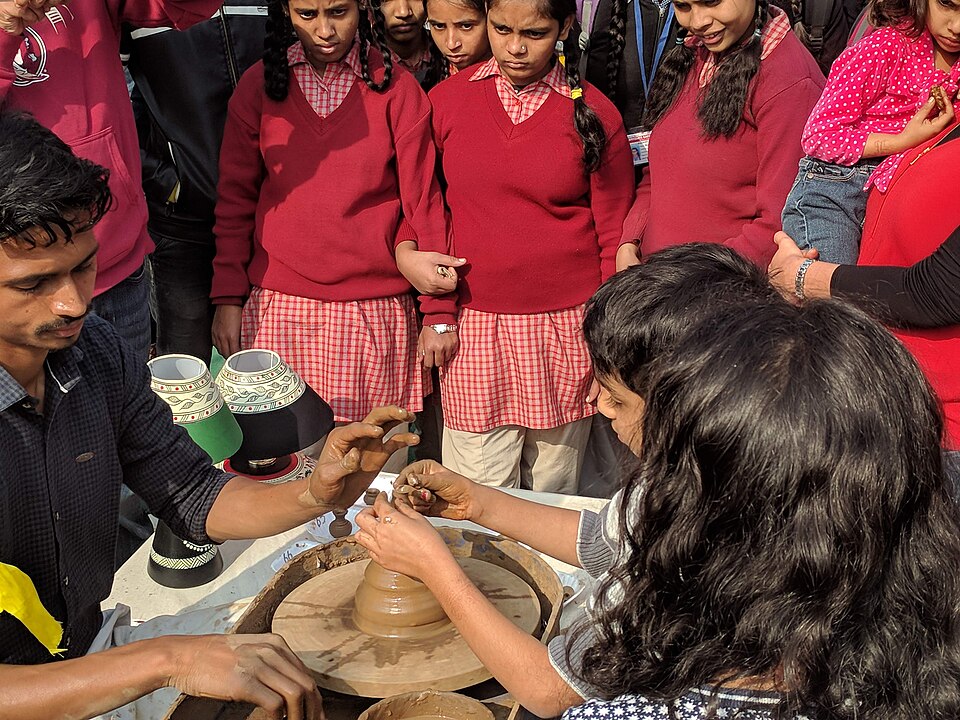
One of the most iconic tools in ceramics is the pottery wheel, a flat disk that spins while the potter shapes wet clay with their hands. The potter’s wheel was invented around 3500 BCE in Mesopotamia (modern-day Iraq) and transformed how people made containers. Before the wheel, every pot had to be built by hand using coils or pinching. The wheel allowed potters to create perfectly round, symmetrical vessels much more quickly.
Using a pottery wheel is called “throwing,” and it takes significant practice to master. The potter begins by centering a lump of wet clay on the spinning wheel, then uses gentle, steady pressure from both hands to open a hole in the center and pull the walls upward. The spinning motion and the water keep the clay smooth and even. A skilled potter can throw a tall vase in just a few minutes.
Kilns and Firing
A kiln is a specialized oven that reaches temperatures far higher than a kitchen oven, sometimes over 1,200 degrees Celsius (about 2,200 degrees Fahrenheit). Firing clay in a kiln causes chemical changes in the minerals that make the clay permanently hard and waterproof. Most pottery goes through the kiln twice. The first firing, called a bisque firing, hardens the clay. The artist then applies a glaze, which is a liquid coating made from ground minerals, and fires the piece a second time. The glaze melts in the heat and forms a glassy, colorful, waterproof surface.
Ancient potters built kilns from stone and brick and fueled them with wood. Modern kilns are typically powered by electricity or natural gas and have precise digital temperature controls. Some artists still use traditional wood-fired kilns because the ash and flame create unpredictable, beautiful surface effects that cannot be replicated any other way.
Famous Sculptures and History
Clay sculpture has a long history spanning every continent. The oldest known clay figurine is the Venus of Dolni Vestonice, a small figure found in the Czech Republic that is approximately 29,000 years old. The Terracotta Army of China, created around 210 BCE for Emperor Qin Shi Huang, consists of thousands of life-sized clay soldiers, horses, and chariots buried to protect the emperor in the afterlife. Each soldier has a unique face, suggesting that real individuals may have served as models.
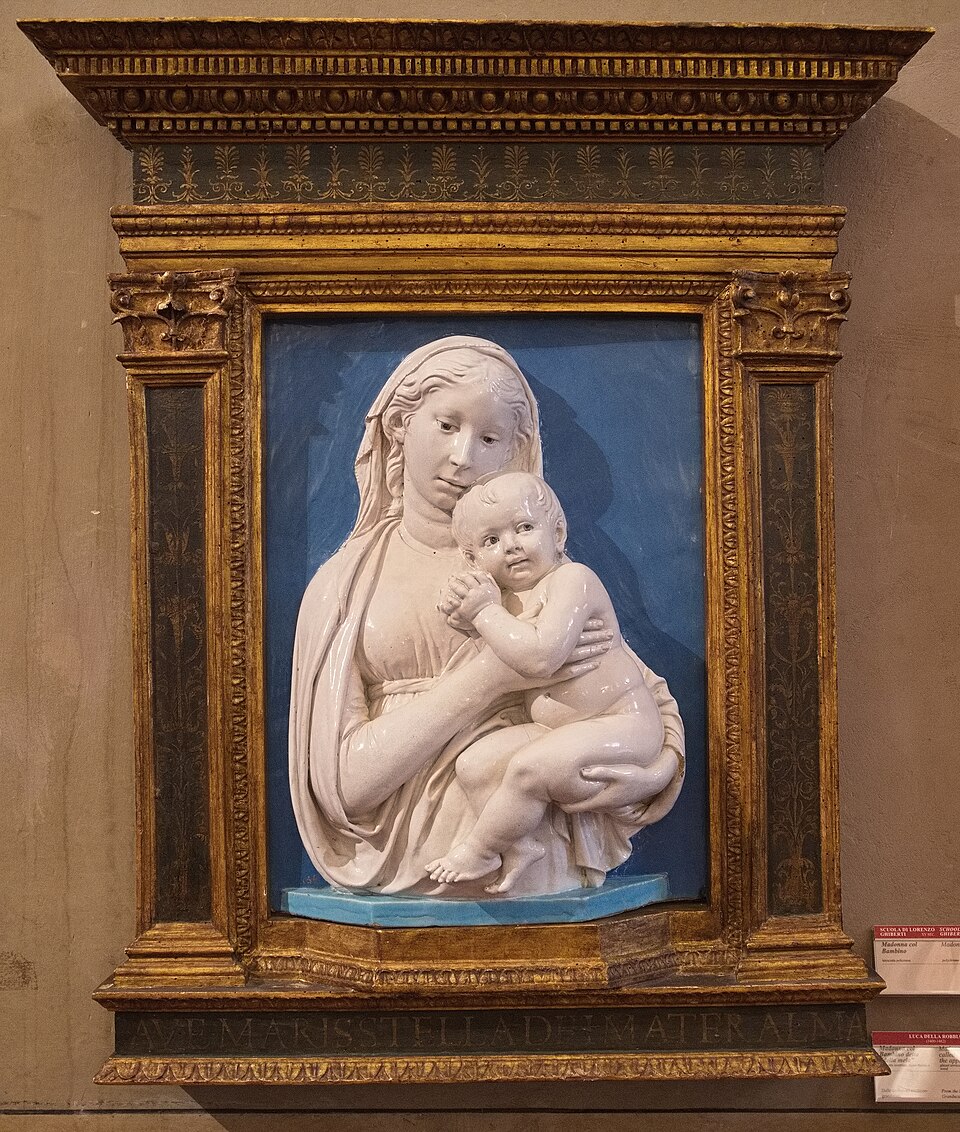
In the Americas, the ancient Maya and Moche civilizations created elaborate clay vessels decorated with detailed scenes of daily life and mythology. In West Africa, the Nok civilization produced striking terracotta sculptures of human heads as early as 500 BCE. During the Italian Renaissance, artists like Luca della Robbia became famous for glazed terracotta reliefs that decorated churches and public buildings across Florence.
Fun Facts
The word “ceramic” comes from the Greek word “keramos,” meaning potter’s clay. The oldest known pottery vessels, found in a cave in China, are approximately 20,000 years old and were likely used for cooking. Japan’s Jomon pottery, some of the world’s oldest, gets its name from the cord-marked patterns pressed into the wet clay before firing. Modern NASA engineers have used ceramic materials inspired by ancient pottery techniques to create heat shields for spacecraft, because ceramics can withstand extreme temperatures without melting. Today, clay and ceramics are used not only in art but also in electronics, medicine, and construction.
 OtterKnow Kids Encyclopedia