What They Look Like
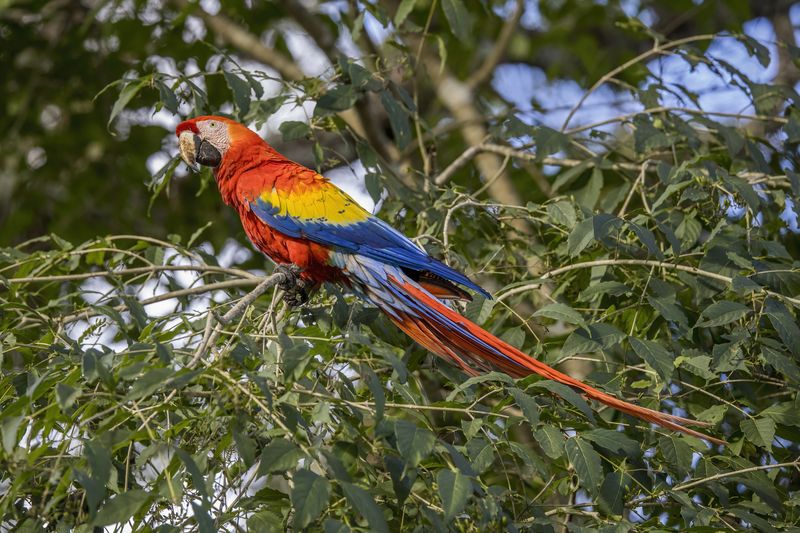
Macaws are built for life in the treetops. Most species measure between 30 and 40 inches from head to tail, and the Hyacinth Macaw — the largest of all — can stretch over 3 feet long. Their feathers come in vivid combinations of red, blue, yellow, and green, which actually help them blend in with the bright fruits and flowers of the rainforest canopy. One of the macaw’s most powerful features is its curved beak, which is strong enough to crack open Brazil nuts and even coconut shells. Each macaw also has a unique pattern of tiny feathers on its face, almost like a human fingerprint.
Clay Licks
One of the most remarkable behaviors in the animal kingdom happens at riverbanks deep in the Amazon rainforest. Hundreds of macaws gather at exposed clay cliffs, called clay licks, where they nibble and swallow mouthfuls of clay. Scientists believe the clay helps neutralize toxins found in the unripe seeds and fruits that macaws eat. The minerals in the clay may also provide important nutrients like sodium, which is hard to find in a rainforest diet. These clay lick gatherings are a spectacular sight, with dozens of brightly colored macaws clinging to the cliff face at once, chattering loudly as they eat.
Vocalizations
Macaws are among the noisiest birds in the rainforest, and their loud squawks and screams can carry for several miles through dense forest. They use these calls to communicate with their flock, warn of predators, and keep track of their mates. Each species has its own distinct set of calls, and individual macaws can even recognize each other by voice. In captivity, macaws are famous for their ability to mimic human speech and other sounds, though in the wild they stick to their own language. Their vocal skills are a sign of their high intelligence — macaws are considered one of the smartest bird families in the world.
Pair Bonds and Social Life
Macaws are deeply social birds that live in flocks of 10 to 30 individuals, and sometimes gather in groups of hundreds at roosting sites. Within these flocks, macaws form lifelong pair bonds, meaning a male and female will stay together as mates for their entire lives, which can span 50 to 60 years or more. Bonded pairs fly close together, share food, groom each other’s feathers, and raise their chicks as a team. If one mate dies, the surviving macaw sometimes refuses to pair with another bird. This strong social behavior helps macaws cooperate in finding food, watching for danger, and raising healthy young.
What They Eat
Macaws are herbivores that feast on a wide variety of seeds, nuts, fruits, and flowers found in the rainforest canopy. Their powerful beaks act like built-in nutcrackers, allowing them to break open tough shells that other animals cannot reach. Some favorite foods include palm nuts, figs, and the seeds of tropical hardwood trees. Macaws also eat bark and insects occasionally, adding extra protein and nutrients to their diet. Because they feed on so many different plant species, macaws play an important role as seed dispersers — they carry seeds to new locations, helping the rainforest grow and stay healthy.
Where They Live
Most macaw species live in the tropical rainforests of Central and South America, from southern Mexico down through Brazil and Bolivia. Different species prefer different habitats within this range: Scarlet Macaws favor lowland rainforests, while some smaller species live in dry woodlands or savannas. The Amazon Basin is the heart of macaw territory, where the greatest number of species overlap. Macaws nest in natural cavities high up in large trees, and competition for good nesting holes can be fierce. A few species, like the Spix’s Macaw, have such limited ranges that they have become critically endangered or even extinct in the wild.
Conservation
Macaws face serious threats from habitat loss and the illegal pet trade. Deforestation for farming and logging destroys the large, old-growth trees that macaws need for nesting, and it removes the fruit and nut trees they depend on for food. For decades, poachers captured wild macaws to sell as exotic pets, which devastated some populations. The Spix’s Macaw was declared extinct in the wild in 2000, though captive breeding programs are now working to reintroduce the species. Conservation organizations across Latin America are protecting rainforest habitat, installing artificial nest boxes, and enforcing laws against the wildlife trade to give macaws a fighting chance at survival.
 OtterKnow Kids Encyclopedia