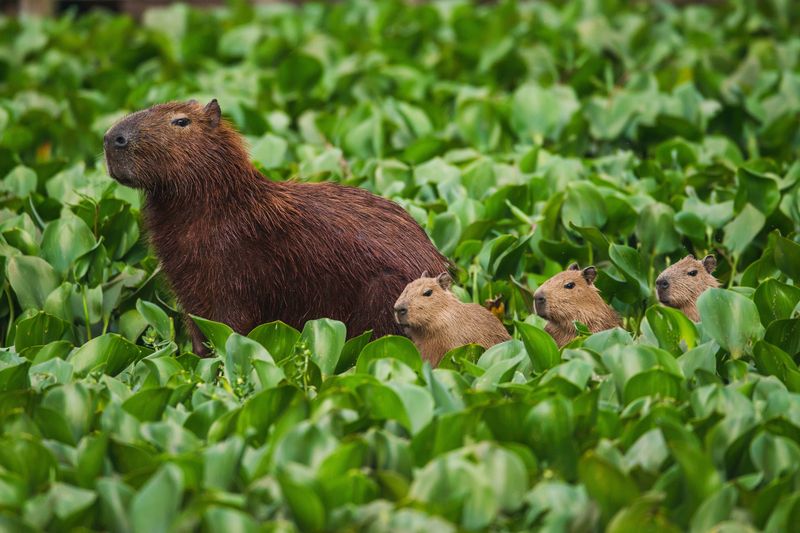
The World’s Largest Rodent
Rodents are the largest group of mammals on Earth, and the capybara towers over every other member. An adult capybara can weigh up to 65 kilograms (about 143 pounds) and measure over 1.2 meters (4 feet) long, making it roughly the size of a large dog. To put that in perspective, a common house mouse weighs only about 20 grams, which means a capybara is more than 3,000 times heavier. Despite their impressive size, capybaras are closely related to guinea pigs and rock cavies, all of which belong to the same family of South American rodents called Caviidae.
What They Look Like
Capybaras have a stocky, rounded body covered in coarse, brownish fur that dries quickly after a swim. Their heads are large and blunt, with small ears and eyes set high on top so they can see, hear, and breathe while the rest of their body stays underwater. Each foot has slightly webbed toes, which help them paddle through the water with ease. Like all rodents, capybaras have large front teeth that never stop growing, so they must chew on tough grasses and bark to keep their teeth worn down to the right length.
Semi-Aquatic Life
Capybaras are semi-aquatic, meaning they split their time between land and water. They are excellent swimmers and can hold their breath underwater for up to five minutes to hide from predators like jaguars, caimans, and anacondas. Water also helps capybaras regulate their body temperature, since they do not sweat efficiently the way humans do. On hot days, herds often wade into a river or pond and stay submerged up to their nostrils, looking like a collection of furry boulders poking out of the water. They even mate in the water, and mothers sometimes nurse their young while standing in the shallows.
Social Groups
Capybaras are highly social animals that live in groups of 10 to 20 individuals, though during the dry season herds can swell to 100 or more as animals gather around shrinking water sources. Each group is usually led by a dominant male, with several females, their young, and a few subordinate males making up the rest. Group members communicate with a surprisingly wide range of sounds, including barks, whistles, clicks, and a distinctive purring sound that signals contentment. Living in a group provides safety in numbers: while some capybaras graze, others keep watch for predators and let out a sharp alarm bark if danger is spotted.
A Favorite Perch
One of the most charming things about capybaras is how other animals treat them like living furniture. Birds such as cattle egrets, yellow-headed caracaras, and wattled jacanas regularly perch on the backs of resting capybaras, picking off ticks and other parasites as they go. Small monkeys, rabbits, and even other capybara pups have been photographed sitting on top of adults. Scientists believe capybaras tolerate this behavior because the birds help remove bothersome insects, creating a mutually beneficial relationship. Their calm, unbothered nature around other species has earned them a reputation as one of the friendliest animals in the natural world.
What They Eat
Capybaras are herbivores that feed mainly on grasses and aquatic plants. They graze in the early morning and late evening when temperatures are cooler, and an adult can eat around 3 kilograms (about 6.5 pounds) of vegetation per day. Their digestive system is specially adapted to break down tough plant fibers, and like rabbits, they practice coprophagy, which means they eat their own droppings to absorb extra nutrients that were missed the first time through. During the wet season when grasses are plentiful, capybaras build up fat reserves that help carry them through the dry months when food is harder to find.
Where They Live
Capybaras are found across much of South America, from Panama in the north to Argentina in the south. They live in a variety of habitats as long as there is a body of water nearby, including tropical rainforests, savannas, wetlands, and flooded grasslands. The Pantanal, the world’s largest tropical wetland, which stretches across parts of Brazil, Bolivia, and Paraguay, is home to especially large populations. Although they are hunted in some areas for their meat and leather, capybaras remain widespread and are listed as a species of Least Concern by the International Union for Conservation of Nature (IUCN). In some parts of South America, ranchers even raise capybaras alongside cattle because the two species graze peacefully side by side.
 OtterKnow Kids Encyclopedia