What They Look Like
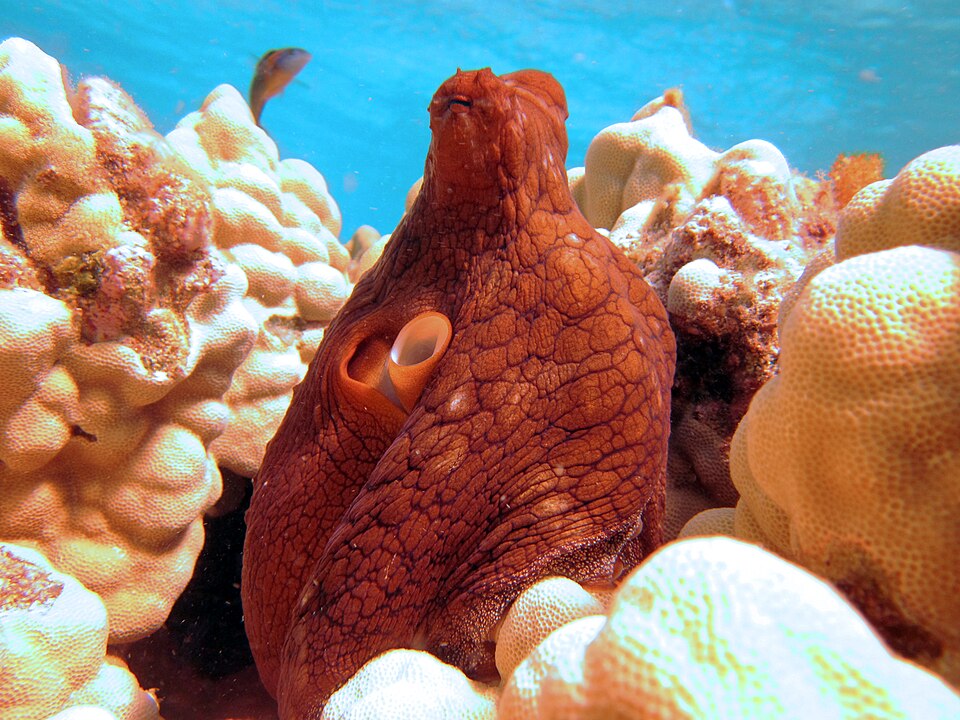
An octopus has a rounded, bag-like body called a mantle, eight flexible arms, and two large eyes that give it excellent vision. Because it has no skeleton, an octopus can flatten and reshape its entire body to fit through any gap wider than its hard beak, which is the only rigid part of its body. That beak, located where the arms meet, looks similar to a parrot’s beak and is strong enough to crack open crab and clam shells. Most octopuses range in size from just a few centimeters across to about one meter, though the giant Pacific octopus can stretch up to five meters from arm tip to arm tip and weigh more than 45 kilograms. Their skin is covered with special cells that can change color and texture in a fraction of a second, making octopuses some of the most visually striking creatures in the ocean.
Nine Brains and Three Hearts
One of the most extraordinary things about an octopus is its circulatory and nervous system. An octopus has three separate hearts: two smaller branchial hearts pump blood through the gills to pick up oxygen, while a larger central heart sends that oxygenated blood to the rest of the body. Interestingly, the central heart actually stops beating when the octopus swims, which is why octopuses prefer crawling along the ocean floor rather than swimming long distances. Their blood is blue instead of red because it uses a copper-based molecule called hemocyanin to carry oxygen, which works better than iron-based hemoglobin in cold, low-oxygen water. On top of all that, an octopus has nine brains: one central brain in its head and a smaller cluster of neurons in each of its eight arms, giving every arm the ability to taste, touch, and react on its own.
Eight Intelligent Arms
Each of an octopus’s eight arms is lined with hundreds of powerful suction cups that can grip, taste, and smell all at the same time. The arms can operate somewhat independently because of the cluster of neurons inside each one, so an octopus can explore a crevice with one arm while using another to pry open a shell. Scientists have observed octopuses unscrewing jar lids from the inside, navigating complex mazes, and even stacking rocks to build shelters outside their dens. In laboratory experiments, octopuses have learned to solve problems by watching other octopuses, a skill that is very rare among invertebrates. Some species, like the veined octopus, carry coconut shell halves along the seafloor and assemble them into a protective shelter when threatened, which is one of the clearest examples of tool use in any animal without a backbone.
Masters of Camouflage
Octopuses are among the best camouflage artists in the entire animal kingdom. Their skin contains thousands of tiny cells called chromatophores, each filled with a different pigment that can expand or contract in milliseconds. Beneath the chromatophores are reflective cells called iridophores and light-scattering cells called leucophores, which work together to create an incredible range of colors, patterns, and even textures. An octopus can match the look of sand, coral, rocks, or algae so perfectly that it becomes almost invisible to both predators like sharks and the prey it is hunting. The mimic octopus takes this skill even further by changing its body shape and movement to impersonate other animals, including lionfish, flatfish, and sea snakes.
Ink and Other Defenses
When camouflage is not enough, octopuses have several backup escape plans. Their most famous trick is squirting a thick cloud of dark ink from a special gland near their gills, which confuses predators and gives the octopus time to jet away. The ink contains a compound called tyrosinase that can irritate a predator’s eyes and dull its sense of smell, making it even harder to follow the fleeing octopus. Octopuses escape by using jet propulsion, drawing water into their mantle and then forcing it out through a muscular tube called a siphon, which shoots them backward at high speed. If a predator does manage to grab an arm, the octopus can detach it voluntarily; the severed arm continues to wriggle and distract the attacker while the octopus escapes, and over time the arm grows back completely.
Life Cycle
The life cycle of an octopus is dramatic and, in many ways, tragic. After mating, a female octopus lays thousands of tiny eggs, often stringing them together in clusters that she attaches to the ceiling of her den. She then guards and cleans the eggs constantly, gently blowing water over them to keep them oxygenated, and she stops eating entirely during this period, which can last weeks or even months. When the eggs finally hatch, the tiny hatchlings drift into the open ocean as plankton, and only a small fraction will survive to adulthood. The mother, weakened from her long vigil without food, dies shortly after the eggs hatch. Males also die soon after mating, meaning that octopuses reproduce only once in their lifetime, a strategy scientists call semelparity.
Octopuses and Science
Scientists study octopuses to learn about intelligence, evolution, and the nervous system. Because octopus brains evolved completely separately from mammal brains, studying how they think helps researchers understand whether there are different ways for intelligence to develop in nature. Octopuses have also inspired engineers and roboticists who are building soft, flexible robots modeled after their boneless arms. Researchers have found that octopuses can edit their own RNA, the molecule that carries genetic instructions inside cells, which is extremely rare in the animal kingdom and could lead to new discoveries in medicine. Their ability to regenerate lost arms is another area of active research, as understanding how octopuses regrow complex tissue could someday help scientists develop better treatments for human injuries. From the deep ocean to the laboratory, the octopus continues to surprise and teach us about what is possible in the living world.
 OtterKnow Kids Encyclopedia