What They Look Like
Most dolphins have sleek, streamlined bodies designed for fast, efficient swimming. The common bottlenose dolphin typically measures between 2 and 4 meters (6 to 13 feet) long and weighs around 150 to 650 kilograms (330 to 1,430 pounds). Their skin is smooth and rubbery, usually gray on top and lighter underneath, a color pattern called countershading that helps them blend in whether seen from above or below. Dolphins have a curved dorsal fin on their backs, two pectoral flippers, and a powerful tail fluke that moves up and down to propel them through the water at speeds of up to 32 kilometers per hour (20 miles per hour). Their long snouts, called rostrums, are lined with small, cone-shaped teeth used for catching fish rather than chewing, since dolphins swallow their prey whole.
Echolocation
One of the dolphin’s most impressive abilities is echolocation, a kind of biological sonar that lets them “see” with sound. A dolphin produces rapid clicking sounds in its nasal passages, and these clicks travel through a fatty organ in its forehead called the melon, which focuses the sound into a beam. When the clicks hit an object such as a fish or the ocean floor, the sound bounces back as an echo. The dolphin picks up these echoes through its lower jaw, which channels the vibrations to its inner ear and brain. Using echolocation, a dolphin can determine the size, shape, distance, and even the internal structure of an object, making it possible to hunt in murky water or total darkness.
Names and Communication
Dolphins are among the most vocal animals in the ocean, producing a rich variety of whistles, clicks, and burst-pulse sounds. One standout example is the signature whistle, a unique pattern of sounds that each dolphin develops within the first few months of life and keeps for its entire lifetime. Scientists have found that dolphins use these signature whistles much like names, calling out to specific individuals and responding when their own whistle is used. Dolphins can remember the signature whistles of companions they have not encountered for over 20 years, suggesting they have powerful long-term memories. They also use body language, including leaps, tail slaps, jaw claps, and synchronized swimming, to express emotions and coordinate group activities.
Intelligence and Culture
Dolphins are considered some of the most intelligent animals on the planet, alongside great apes and elephants. Their brains are large relative to their body size, and their cerebral cortex, the part of the brain associated with complex thinking, is highly developed. In studies, dolphins have demonstrated self-awareness by recognizing themselves in mirrors, a skill that very few animals possess. Bottlenose dolphins in Shark Bay, Australia, have been observed carrying sea sponges on their rostrums to protect their snouts while foraging on the seafloor, a behavior that mothers teach to their daughters across generations. This kind of learned behavior passed from one generation to the next is what scientists call cultural transmission, and it shows that dolphins do not rely on instinct alone but also learn skills from each other.
Pods and Social Life
Dolphins are highly social animals that live in groups called pods, which can range from a handful of individuals to several hundred or even a thousand in some oceanic species. Within a pod, dolphins form close bonds, cooperate during hunts, and look after sick or injured members by supporting them at the surface so they can breathe. They work together to herd schools of fish into tight balls called bait balls, taking turns swimming through to feed. Dolphins also engage in play, chasing each other, surfing waves, tossing seaweed, and blowing bubble rings that they then swim through. One of the most unusual features of dolphin biology is unihemispheric sleep, in which one half of the brain rests while the other half stays alert, allowing the dolphin to keep swimming, breathing, and watching for predators even while sleeping.
Where They Live
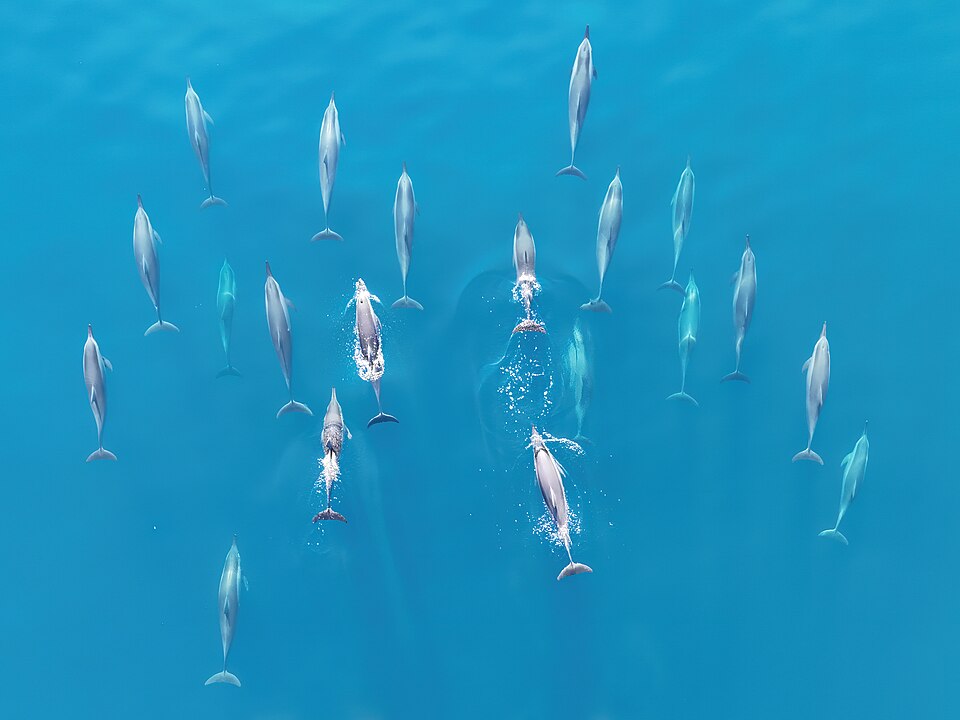
Dolphins are found in nearly every ocean on Earth, from warm tropical seas to the cold waters near the poles. The common bottlenose dolphin prefers temperate and tropical coastal waters, while species like the spinner dolphin and the pantropical spotted dolphin inhabit the deep open ocean. Some dolphins have even adapted to life in freshwater rivers; the Amazon river dolphin, or boto, swims through the flooded forests of South America. Dolphins share their ocean habitat with many other marine creatures, including blue whales, narwhals, and sharks. Their close relative the orca, sometimes called the killer whale, is actually the largest member of the dolphin family, reaching lengths of up to 9 meters (30 feet).
Conservation
While some dolphin species remain abundant, others face serious threats from human activities. Bycatch, the accidental capture of dolphins in fishing nets meant for other species, kills hundreds of thousands of dolphins every year worldwide. Pollution is another major concern, as chemicals, plastics, and oil spills contaminate the water dolphins live in and the fish they eat. Noise pollution from ships, sonar, and underwater construction can interfere with their echolocation and communication. The baiji, or Chinese river dolphin, was declared functionally extinct in 2007, serving as a stark reminder that these animals are not immune to human impact. Many countries now have laws protecting dolphins, and international agreements work to reduce bycatch and preserve the ocean habitats that dolphins depend on for survival.
 OtterKnow Kids Encyclopedia