What They Look Like
Horses are large, muscular animals with long legs built for speed and endurance. They have a single solid hoof on each foot, a long flowing mane along the neck, and a tail made of thick, coarse hair. Their coats come in a wide range of colors and patterns, including bay (reddish-brown with a black mane and tail), chestnut, black, gray, palomino, and pinto. An average riding horse stands about 1.4 to 1.7 meters (roughly 14 to 17 hands) tall at the shoulder, and a hand, the traditional unit for measuring horses, equals about 10 centimeters (4 inches). Horses have large, expressive eyes set on the sides of their heads, giving them a remarkably wide field of vision that stretches nearly 360 degrees around their bodies.
Evolution of the Horse
The story of horse evolution is one of the most complete in the fossil record. The earliest known ancestor, called Eohippus (also known as Hyracotherium), lived about 55 million years ago and looked nothing like a modern horse. It was only about the size of a small dog, stood on four toes on its front feet and three on its back, and browsed on soft leaves in tropical forests. Over millions of years, as grasslands spread across the continents, horses gradually grew larger, developed longer legs for running, and their multiple toes fused into a single strong hoof. By around 5 million years ago, the genus Equus had appeared, looking much like the horses we know today.
Senses and Communication
Horses have sharp senses that helped their wild ancestors survive on open grasslands where predators could appear at any moment. Their nearly 360-degree field of vision means they can see almost everything around them without turning their heads, though they have small blind spots directly in front of their noses and behind their tails. Their ears can rotate nearly 180 degrees independently, allowing them to pinpoint sounds coming from different directions at the same time. Horses communicate with each other through a rich combination of body language, vocalizations, and facial expressions. A horse’s ear position, tail movement, and even the tension in its nostrils all send signals to other horses, and they also use sounds such as whinnies, nickers, and snorts to express everything from excitement to warning.
Gaits
A gait is the pattern of leg movements a horse uses to travel at different speeds. All horses naturally have four basic gaits: the walk, trot, canter, and gallop. The walk is the slowest and most relaxed, with each hoof hitting the ground separately in a four-beat rhythm. The trot is a two-beat gait where diagonal pairs of legs move together, making the rider bounce unless they learn a technique called posting. The canter is a smooth, three-beat gait that feels like a rocking motion, while the gallop is the fastest gait, reaching speeds of up to 70 kilometers per hour (about 44 miles per hour) in short bursts. Some breeds, such as the Icelandic horse and the Tennessee Walking Horse, have additional natural gaits that give an especially smooth ride.
History and Domestication
Humans first domesticated horses roughly 5,500 years ago on the grasslands of Central Asia, in the region that is now Kazakhstan and Ukraine. Early people probably tamed horses for their milk and meat before realizing they could be ridden. Once people learned to ride, horses transformed human civilization almost overnight by making travel, trade, and warfare far faster and more powerful. Mounted warriors on horseback conquered vast empires, from the Mongols sweeping across Asia to Spanish conquistadors arriving in the Americas. Horses also powered agriculture, hauled freight along trade routes, delivered mail across continents, and served as the primary mode of transportation in most societies until cars and trains replaced them in the early 1900s.
Breeds and Uses
With more than 300 breeds, horses have been developed for nearly every imaginable purpose. Thoroughbreds are famous for their speed on the racetrack, while stocky Quarter Horses excel at quick sprints and working with cattle on ranches. Enormous draft breeds like the Clydesdale and the Shire were originally bred to pull heavy loads, including farm equipment and cargo wagons. Arabian horses, one of the oldest and most recognizable breeds, are prized for their stamina and can cover huge distances in endurance races. Smaller breeds like the Shetland pony are popular for younger riders and as companion animals, proving that there truly is a horse for every job and every rider.
How Horses Live
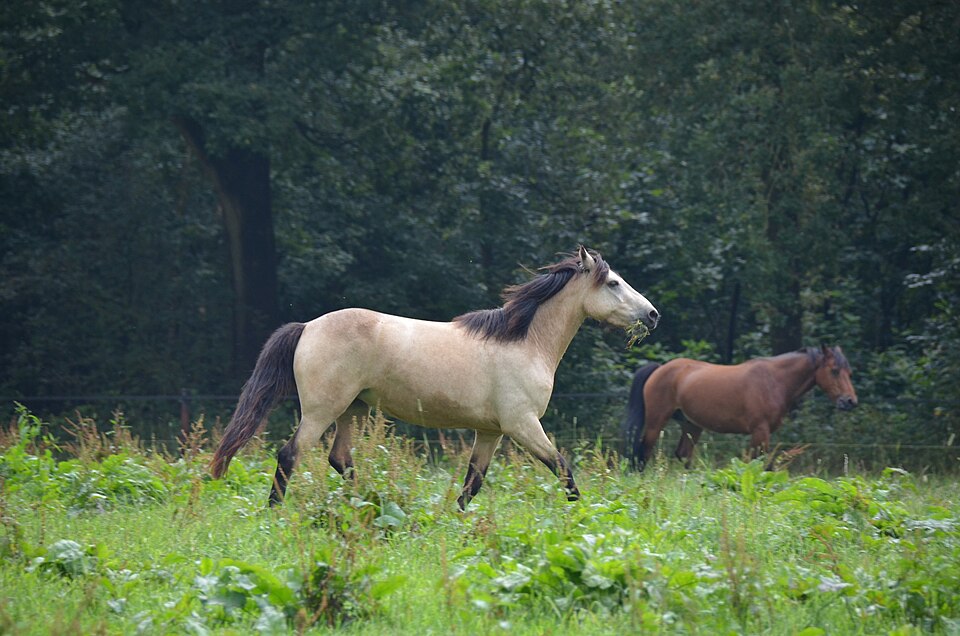
Horses are social herd animals that feel safest in the company of others. In the wild, they live in small groups called bands, usually made up of one stallion (adult male), several mares (adult females), and their young, known as foals. One of the most surprising things about horses is that they can sleep standing up, thanks to a special locking mechanism in their leg joints called the stay apparatus, though they do lie down for short periods of deep sleep. Horses are herbivores that spend much of their day grazing on grass, and a full-grown horse can eat about 10 kilograms (22 pounds) of food and drink 30 to 50 liters (8 to 13 gallons) of water each day. In the wild, horses may live into their mid-twenties, while well-cared-for domestic horses often reach 25 to 30 years of age.
Horses Today
Although cars, trucks, and tractors have replaced horses in most everyday work, these remarkable animals remain deeply woven into human life. Millions of people around the world ride horses for recreation, sport, and therapy, and equestrian events like show jumping, dressage, and polo are among the few Olympic sports where humans and animals compete as a team. Horses also serve in police units, assist in search-and-rescue missions, and provide therapeutic riding programs that help people with physical and emotional challenges. Wild and feral horse populations still roam in places like the American West, the Australian outback, and the steppes of Mongolia, reminding us of the freedom and power that first drew humans to these animals thousands of years ago.
 OtterKnow Kids Encyclopedia