What It Looked Like
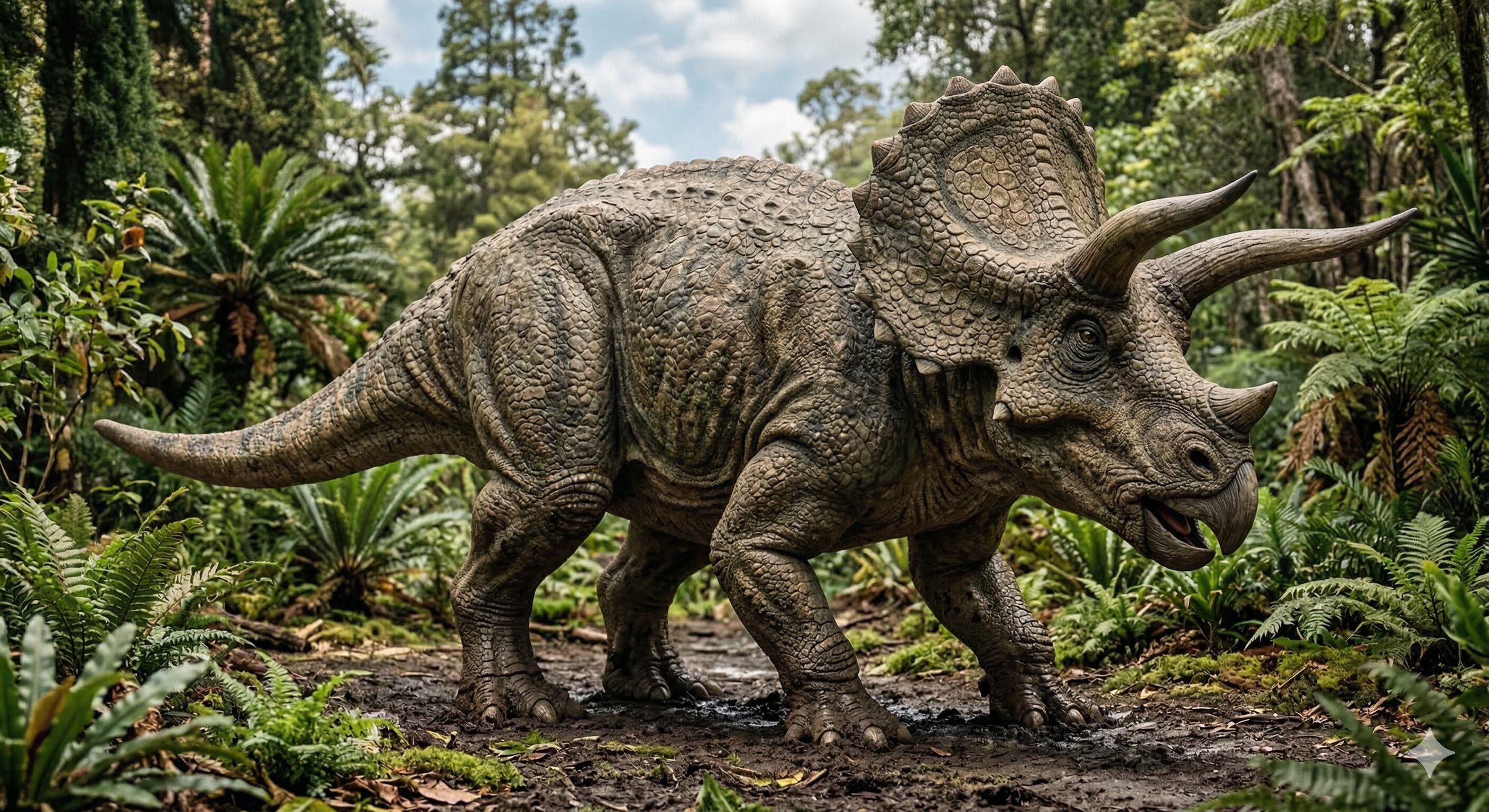
Triceratops was a massive animal, roughly the size of a modern bus. Adults could grow up to 9 meters (about 30 feet) long and stand nearly 3 meters (10 feet) tall at the hips. Scientists estimate that a full-grown Triceratops weighed between 6,000 and 12,000 kilograms (roughly 6 to 12 tons), making it one of the heaviest plant-eating dinosaurs of its time. It walked on four sturdy legs, with the front legs being somewhat shorter than the back legs, giving it a posture a bit like a modern rhinoceros. Its body was thick and barrel-shaped, built for strength rather than speed.
The Three Horns
The most striking feature of Triceratops was its three horns. Two long brow horns sat above its eyes, each reaching up to a meter (about 3 feet) in length, while a shorter horn rested on its nose. Scientists have debated for over a century exactly how these horns were used. They may have served as weapons for defending against predators or for competing with other Triceratops over territory and mates. Fossils of Triceratops skulls sometimes show healed injuries on the horns and frill, which suggests that these dinosaurs did clash with one another from time to time.
The Frill
Behind the horns, Triceratops had a wide, solid bony frill that extended from the back of its skull over its neck. Unlike the frills of some related ceratopsians, such as Torosaurus, the Triceratops frill was mostly solid bone without large openings. This frill may have protected the neck from bites, but many paleontologists now believe it served other purposes as well. It could have been brightly colored or patterned, helping Triceratops recognize members of its own species or attract mates. The frill also anchored powerful jaw muscles, giving Triceratops an incredibly strong bite for slicing through tough plants.
What It Ate
Triceratops was a herbivore, meaning it ate only plants. Its mouth ended in a narrow, parrot-like beak that was perfect for snipping ferns, cycads, and other low-growing vegetation. Behind the beak, rows of tightly packed teeth called dental batteries worked together to slice and crush tough plant material. As old teeth wore down, new ones grew in to replace them, so Triceratops always had a fresh set ready for chewing. During the Late Cretaceous, flowering plants were becoming more common, and Triceratops likely fed on a mix of older plant types and these newer arrivals.
Where It Lived
Fossils of Triceratops have been found across western North America, in present-day states like Montana, Wyoming, South Dakota, and Colorado, as well as the Canadian provinces of Alberta and Saskatchewan. During the Late Cretaceous, this region featured warm, humid plains with rivers, floodplains, and patches of forest. Triceratops shared this landscape with many other dinosaurs, including the armored Ankylosaurus, the duck-billed Edmontosaurus, and of course the mighty Tyrannosaurus rex. Some paleontologists have found groups of Triceratops fossils buried together, which may be evidence that these dinosaurs lived in herds for at least part of their lives.
Triceratops vs. T. Rex
Few matchups in prehistory are as legendary as Triceratops facing off against Tyrannosaurus rex. These two giants lived in the same places at the same time, and fossil evidence strongly suggests they interacted. Scientists have found Triceratops bones with T. rex bite marks gouged into them, and some Triceratops frills bear puncture wounds that match the size and spacing of tyrannosaur teeth. Whether T. rex actively hunted healthy Triceratops or mostly scavenged already-dead ones is still debated. A head-on charge from a Triceratops, with its long brow horns aimed forward, would have been a serious threat even to the most powerful predator of the Cretaceous.
How We Know About It
The first Triceratops fossils were discovered in 1887 near Denver, Colorado. Paleontologist Othniel Charles Marsh originally thought the horns belonged to an ancient bison before realizing they came from a dinosaur. He named the animal Triceratops in 1889. Since then, scientists have uncovered hundreds of Triceratops specimens, making it one of the most common dinosaur fossils from the end of the Cretaceous. Researchers study the growth rings in Triceratops bones to figure out how fast they grew and how long they lived. Some of the most complete skulls are on display at museums like the Smithsonian National Museum of Natural History, where visitors can see the impressive frill and horns up close.
A Lasting Legacy
Triceratops has captured people’s imaginations ever since its discovery more than a century ago. It is the official state dinosaur of Wyoming and one of the first dinosaurs most children learn to name. The sheer number of fossils found tells scientists that Triceratops was one of the most common large dinosaurs in North America right before the asteroid impact that ended the age of dinosaurs about 66 million years ago. Studying Triceratops helps paleontologists understand how horned dinosaurs evolved, how ecosystems worked at the end of the Cretaceous, and what life was like in a world very different from our own.
 OtterKnow Kids Encyclopedia