What It Looked Like
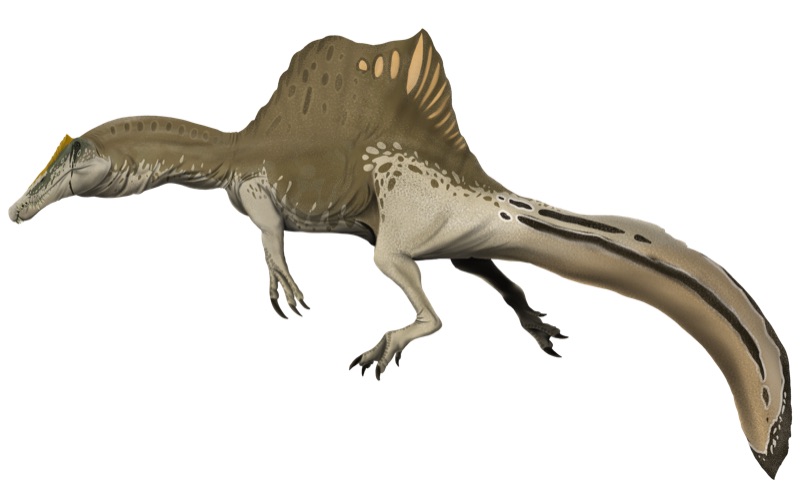
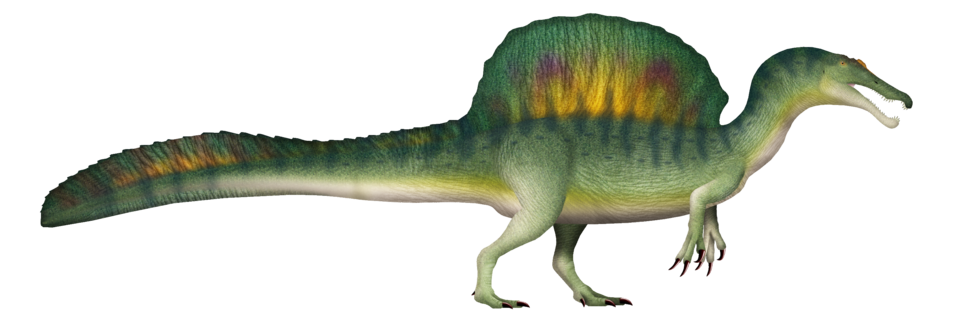
Spinosaurus was an enormous animal built very differently from other big theropod dinosaurs. It had a long, narrow skull shaped somewhat like a crocodile’s, filled with cone-shaped teeth perfect for gripping slippery fish. Its front legs were more muscular and sturdy than those of most theropods, and its hind legs were shorter and more compact than you might expect for a dinosaur of its size. Its feet may have been partially webbed, helping it move through water. A broad, paddle-shaped tail — discovered in 2020 — confirmed that Spinosaurus was well adapted for swimming and could propel itself through rivers and lakes with powerful side-to-side strokes.
The Sail
The most recognizable feature of Spinosaurus was the spectacular structure rising from its back. Tall bony spines extended up from the vertebrae, some reaching nearly two meters high, and were likely connected by skin or tissue to form a sail or rounded hump. Scientists have debated the sail’s purpose for decades. Some researchers think it helped regulate body temperature by absorbing or releasing heat, while others believe it was used for display — attracting mates or intimidating rivals. A more recent idea suggests that the structure may have been a fatty hump, similar to a bison’s, that stored energy for times when food was scarce.
Semi-Aquatic Hunter
Spinosaurus is the first dinosaur scientists have confidently identified as semi-aquatic, meaning it lived both on land and in water. Its dense, heavy bones helped it stay submerged rather than floating on the surface, much like the heavy bones of modern hippos and penguins. The paddle-like tail discovered in Morocco in 2020 was a breakthrough because it showed that Spinosaurus could actively swim, not just wade through shallows. Pressure-sensing pores on its snout, similar to those found in crocodilians, may have helped it detect the movements of fish and other prey underwater. This combination of adaptations paints a picture of an animal that was as comfortable in the water as it was on land.
What It Ate
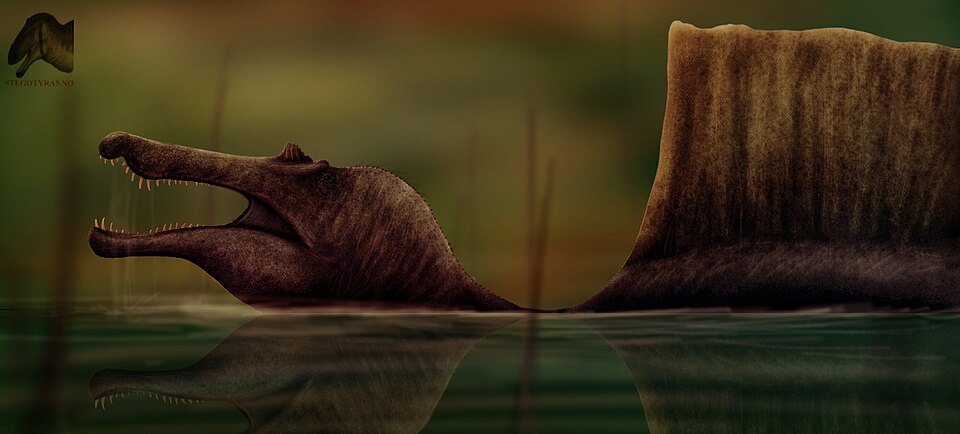
Spinosaurus was primarily a fish eater, a diet scientists call piscivory. The rivers and lakes of Cretaceous North Africa were home to enormous fish, including sawfish and coelacanths that could grow several meters long — more than enough to feed even a giant predator. Chemical analysis of Spinosaurus teeth shows signatures consistent with an aquatic diet, and its interlocking conical teeth were ideal for snagging large, slippery prey. However, Spinosaurus was probably not a picky eater. Fossil evidence suggests it may have also hunted smaller dinosaurs and pterosaurs when the opportunity arose, making it a versatile and formidable predator.
Where It Lived
Spinosaurus lived in what is now North Africa, with fossils found in Morocco, Egypt, and possibly other parts of the Sahara region. During the Cretaceous period, this area looked nothing like the desert it is today. Instead, it was a lush, tropical environment crisscrossed by wide river systems, mangrove swamps, and tidal flats. These warm, shallow waterways teemed with giant fish, sharks, and crocodile-like creatures. Spinosaurus shared this habitat with other large predators, including the dinosaurs Carcharodontosaurus and Deltadromeus, as well as enormous crocodilians like Sarcosuchus.
How We Know About It
The story of Spinosaurus fossils is one of the most dramatic in all of paleontology. German paleontologist Ernst Stromer first described the dinosaur in 1915 from bones found in Egypt’s Bahariya Oasis. Tragically, those original fossils were destroyed when an Allied bombing raid hit the museum in Munich, Germany, during World War II in 1944. For decades afterward, scientists had only Stromer’s drawings and notes to work from. Then, in 2014, paleontologist Nizar Ibrahim and his team announced a spectacular new skeleton from Morocco that revealed Spinosaurus’s unusual body proportions. Further excavations in 2020 uncovered the paddle-shaped tail, reshaping our understanding of how this dinosaur moved and lived.
Spinosaurus vs. T. rex
People often wonder how Spinosaurus would have compared to Tyrannosaurus rex, the most famous predatory dinosaur. In terms of length, Spinosaurus likely had the advantage — it may have been two to three meters longer than the largest T. rex. However, T. rex was probably heavier and more powerfully built, with a bite force that could crush bone. The two dinosaurs were built for very different lifestyles: T. rex was a land-based predator with massive jaws designed to take down large herbivores, while Spinosaurus was a water-adapted hunter specializing in fish. They also never actually met, since T. rex lived in North America about 27 million years after Spinosaurus went extinct.
 OtterKnow Kids Encyclopedia