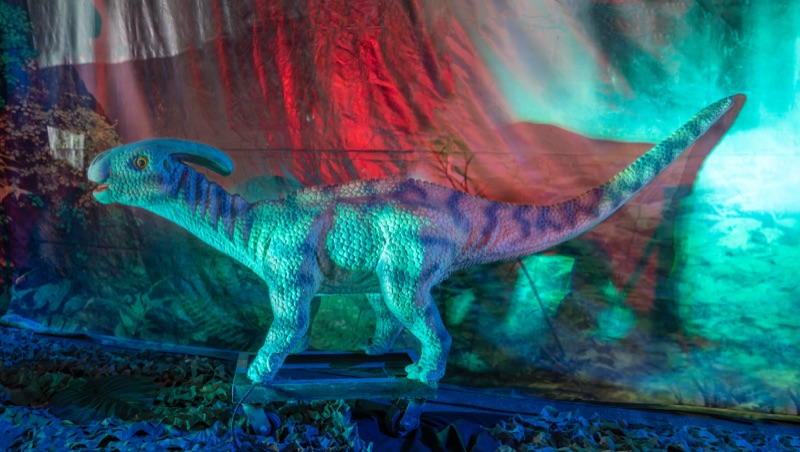
What It Looked Like
Parasaurolophus was a large dinosaur that measured about 10 meters (33 feet) from nose to tail and weighed roughly 2,500 kilograms (about 5,500 pounds). Its body was bulky and muscular, built on powerful hind legs that were longer and stronger than its shorter front limbs. The most striking feature was its tubular crest, which could extend up to 1.8 meters (6 feet) behind the skull in some species. Its snout ended in a broad, flat beak with no front teeth, though hundreds of tightly packed teeth lined the back of its jaws for grinding tough plants. The skin was likely covered in pebbly scales, and some scientists think it may have had bright colors or patterns to help members of the same species recognize each other.
The Hollow Crest
The signature crest of Parasaurolophus was not solid bone but rather a hollow structure with tubes running through it. These tubes were actually extensions of the nasal passages, looping up through the crest and back down into the throat. Scientists once wondered whether the crest stored extra air for underwater breathing or improved the dinosaur’s sense of smell, but those ideas have been mostly ruled out. Today, most paleontologists agree that the crest’s main purpose was producing sound. The hollow passages inside worked much like the tubing of a brass instrument, allowing air to resonate and create deep, booming calls.
Making Sound
By using computer models and CT scans of fossilized crests, scientists have been able to estimate what Parasaurolophus might have sounded like. The long, curved tubes inside the crest would have produced low-frequency sounds similar to a trombone or a foghorn. These deep calls could have traveled long distances through the dense forests where the dinosaur lived, making it easier to communicate with herd members that were far away. Different species of Parasaurolophus had slightly different crest shapes, which means each species probably produced its own unique call. The crest may have also served as a visual signal, helping individuals identify others of their kind or attract mates.
What It Ate
Parasaurolophus was a herbivore that fed on the plants growing in the warm, humid environments of the Late Cretaceous. Its flat, duck-like beak was perfect for cropping leaves, needles, and twigs from trees and shrubs. Behind the beak sat a dental battery of hundreds of small teeth arranged in tightly packed columns, which could grind even the toughest plant material. Parasaurolophus could walk on all four legs to feed on low-growing plants near the ground, then rise up on its two hind legs to reach vegetation higher in the trees. Its diet likely included ferns, conifers, and flowering plants that were becoming more common during this period.
Where It Lived
Fossils of Parasaurolophus have been found in the western parts of North America, including the modern-day states of Utah and New Mexico as well as the Canadian province of Alberta. During the Late Cretaceous, this region was a warm, coastal lowland bordered by the Western Interior Seaway, a shallow sea that split the continent in two. The landscape was filled with rivers, swamps, and forests of conifers and broadleaf trees, providing plenty of food for large plant-eaters. Parasaurolophus shared this environment with many other dinosaurs, including armored ankylosaurs, horned ceratopsians, and fearsome predators like tyrannosaurs.
Herds and Safety
Scientists believe that Parasaurolophus lived in herds, based on fossil sites where multiple hadrosaur skeletons have been found together. Living in a group offered important protection against predators, because many pairs of eyes are better than one for spotting danger. When a Parasaurolophus detected a threat, it could have used its booming crest call to alert the rest of the herd, giving everyone a chance to flee. Although Parasaurolophus had no horns, armor, or claws for fighting, its large size and speed on two legs helped it escape attacks. Young and vulnerable members of the herd would have been safest near the center of the group, surrounded by larger adults.
How We Know About It
The first Parasaurolophus fossil was discovered in 1920 by a fossil collector named William Parks in Alberta, Canada. Since then, several more specimens have been found, including partial skulls and nearly complete skeletons that have taught scientists a great deal about this dinosaur’s anatomy. Advanced technology like CT scanning has allowed researchers to look inside the crest without damaging the fossils, revealing the complex system of tubes hidden within. In 1999, scientists at the New Mexico Museum of Natural History and Science even created a digital reconstruction of the crest and played the sound it might have made, bringing the voice of a 75-million-year-old dinosaur back to life. Each new fossil discovery continues to fill in the picture of how Parasaurolophus lived, moved, and communicated in its ancient world.
 OtterKnow Kids Encyclopedia