A Living Tank
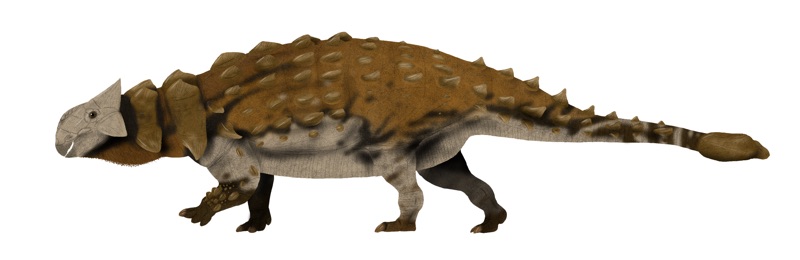
Ankylosaurus is often compared to a living tank because its entire upper body was covered in thick, bony plates called osteoderms. These plates were embedded in the skin and formed rows of armor running from the top of its head down to the tip of its tail. Some osteoderms were flat and smooth, while others rose into ridges and spikes along the dinosaur’s sides and neck. Even its eyelids had small bony plates to protect its eyes. An adult Ankylosaurus could grow up to 8 meters (about 26 feet) long and weigh around 6,000 kilograms (roughly 13,000 pounds), making it about as heavy as a large military vehicle.
The Club Tail
The most famous feature of Ankylosaurus was the massive club at the end of its tail. This club was made of several large osteoderms fused together into a solid, heavy knob. Strong tendons running along the tail allowed Ankylosaurus to swing the club with tremendous force. Scientists estimate that a full swing could deliver enough impact to shatter bone, and some researchers believe a well-aimed blow could even break the ankle of an attacking Tyrannosaurus rex. The tail club made Ankylosaurus one of the few plant-eating dinosaurs that could seriously injure a large predator in a fight.
What It Ate
Despite its fearsome appearance, Ankylosaurus was a peaceful herbivore that spent its days munching on low-growing plants. Its wide, beak-like mouth was well suited for cropping ferns, shrubs, and other vegetation close to the ground. Ankylosaurus had small, leaf-shaped teeth that were designed for simple chewing rather than grinding tough food, so it probably swallowed much of its food in large chunks. Its broad body may have housed a large gut to help break down tough plant material through fermentation, similar to how modern cows digest grass. Scientists think it ate slowly and steadily throughout the day to fuel its massive body.
Where It Lived
Fossils of Ankylosaurus have been found in the western United States and Canada, in states and provinces like Montana, Wyoming, and Alberta. During the Late Cretaceous, this region was a warm, humid lowland bordered by the shallow Western Interior Seaway that once split North America in two. The landscape would have been covered with forests of conifers, ferns, and flowering plants that were just beginning to spread across the world. Ankylosaurus shared this habitat with many other dinosaurs, including Triceratops, Edmontosaurus, and the giant predator T. rex. Rivers and floodplains provided plenty of water and lush vegetation for plant-eating dinosaurs to thrive.
How We Know About It
The first Ankylosaurus fossils were discovered in 1906 by fossil hunter Barnum Brown in the Hell Creek Formation of Montana. Brown, who also discovered the first T. rex skeleton, found pieces of the dinosaur’s armor, ribs, and skull. He named the new dinosaur Ankylosaurus magniventris, with “magniventris” meaning “great belly,” a reference to the animal’s unusually wide body. Complete skeletons of Ankylosaurus are actually quite rare, and much of what scientists know about its full appearance comes from studying related armored dinosaurs. New fossil discoveries and modern technology like CT scanning continue to reveal details about how Ankylosaurus lived and moved.
Other Armored Dinosaurs
Ankylosaurus belonged to a large family of armored dinosaurs called ankylosaurs, which evolved over tens of millions of years. Its earlier relatives, like Euoplocephalus and Sauropelta, also had body armor but differed in the shape and arrangement of their osteoderms. Another well-known armored dinosaur, Stegosaurus, lived much earlier during the Late Jurassic period and used upright bony plates and tail spikes rather than a club. Although Stegosaurus and Ankylosaurus are sometimes confused, they were only distant relatives separated by about 80 million years of evolution. Ankylosaurs have been found on every continent except Africa, showing just how successful armored dinosaurs were as a group.
The End of the Cretaceous
Ankylosaurus was among the very last dinosaurs alive before the catastrophic asteroid impact about 66 million years ago. That asteroid, which struck what is now the Yucatan Peninsula in Mexico, triggered wildfires, tsunamis, and a long period of darkness as dust and debris blocked sunlight around the globe. Temperatures plummeted, plants died off, and the food chain collapsed. Even the heavy armor and powerful tail club of Ankylosaurus could not protect it from a global disaster of that scale. Along with roughly 75 percent of all species on Earth, Ankylosaurus and its fellow non-bird dinosaurs disappeared forever, closing an era that had lasted over 160 million years.
 OtterKnow Kids Encyclopedia