What They Look Like
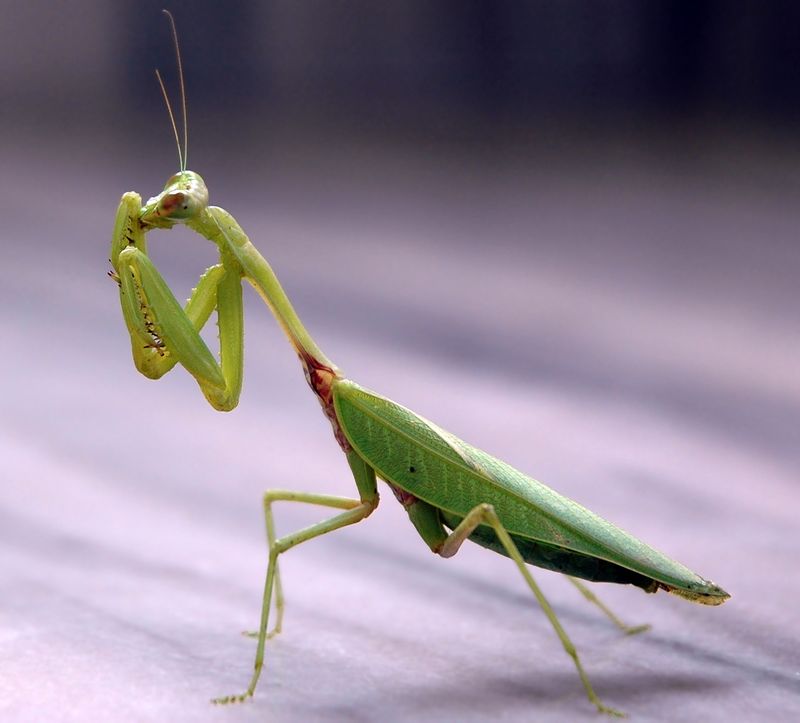
Most praying mantises have long, slender bodies that can range from about one inch to over five inches in length, depending on the species. They have a distinctive triangular head, two large compound eyes, and three smaller simple eyes between them. Their most recognizable feature is a pair of powerful front legs lined with sharp spines, which they use to grip prey tightly. Mantises also have two pairs of wings, though not all species are strong fliers. Their bodies are often colored in shades of green or brown, helping them blend seamlessly into their surroundings.
Camouflage
Mantises are masters of disguise. Many species have evolved body shapes and colors that make them nearly invisible among leaves, twigs, and flowers. The orchid mantis of Southeast Asia, for example, has petal-shaped legs and a pink-and-white body that looks almost exactly like a flower. Other species mimic dried leaves, bark, or even lichen-covered branches. This camouflage serves a double purpose — it hides the mantis from predators like birds, and it also allows the mantis to sit motionless and ambush unsuspecting prey that wanders too close.
The Strike
The praying mantis is an ambush predator, meaning it waits perfectly still for prey to come within reach rather than chasing it down. When an insect gets close enough, the mantis strikes with its front legs in a motion that can take as little as 50 to 70 milliseconds — faster than a human eye can blink. Those spiny front legs snap shut like a trap, gripping the prey so tightly that escape is nearly impossible. Mantises mainly eat other insects like flies, crickets, and moths, but larger species have been known to catch small frogs, lizards, and even hummingbirds. They always eat their food while it is still fresh, consuming it piece by piece.
Vision
Praying mantises have some of the best eyesight of any insect. Their two large compound eyes give them a wide field of view, and they are one of the few insects capable of seeing in three dimensions, a skill called stereoscopic vision. Even more impressive, the praying mantis is the only insect that can rotate its head a full 180 degrees, allowing it to look over its own shoulder. This incredible neck flexibility means a mantis can scan for prey or danger in almost every direction without moving the rest of its body. Scientists have studied mantis vision closely and have even fitted tiny 3D glasses on mantises in laboratories to better understand how their depth perception works.
Where They Live
Praying mantises live on every continent except Antarctica. They are most diverse in tropical and subtropical regions, where warm temperatures and abundant insects provide ideal conditions. However, several species thrive in temperate areas as well, including parts of North America and Europe. Mantises typically make their homes in gardens, meadows, forests, and shrubby areas where there is plenty of vegetation to hide in. The Chinese mantis and the European mantis were both introduced to North America over a century ago and are now common across much of the United States and Canada.
Life Cycle and Egg Cases
A mantis goes through three life stages: egg, nymph, and adult. After mating, the female produces a foamy egg case called an ootheca, which hardens into a protective shell attached to a branch or stem. Each ootheca can contain anywhere from 50 to 200 eggs, depending on the species. In spring, tiny nymph mantises hatch and emerge all at once, looking like miniature versions of the adults but without wings. They molt — shedding their exoskeleton — several times as they grow, and after their final molt they have fully developed wings and are ready to mate. One unusual fact about mantis reproduction is that the female sometimes eats the male during or after mating, which may provide her with extra nutrition to help produce a larger, healthier egg case.
Mantises and Gardens
Many gardeners consider praying mantises to be helpful allies because they eat pest insects like aphids, beetles, and caterpillars. Some garden supply stores even sell oothecae so people can hatch mantises in their own yards. However, mantises are not picky eaters — they will catch beneficial insects like butterflies and bees just as readily as pests. Because of this, scientists say that mantises are best thought of as general predators rather than targeted pest controllers. Still, watching a mantis hunt in a backyard garden remains one of the most exciting ways to observe nature up close, and these patient predators have earned their reputation as one of the insect world’s most impressive hunters.
 OtterKnow Kids Encyclopedia