The Train
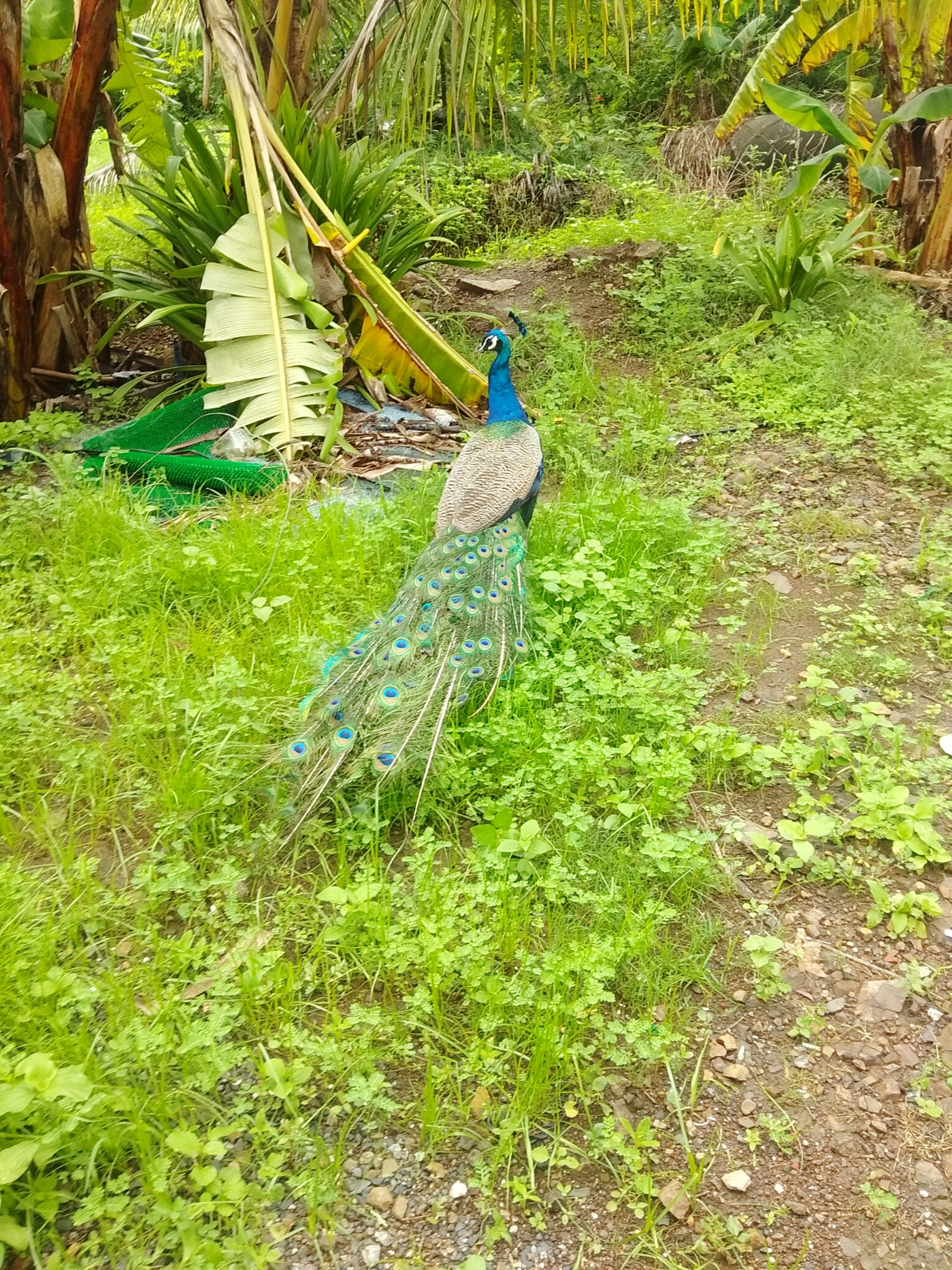
The peacock’s most famous feature is his enormous fan of feathers, which scientists call a “train.” The train is not actually made of tail feathers — it grows from the bird’s back and is supported by shorter, stiffer true tail feathers underneath. A fully grown peacock’s train can stretch more than five feet long and contain around 150 to 200 individual feathers. Each feather is tipped with a shimmering, eye-shaped spot called an ocellus, which gets its brilliant color not from pigment but from microscopic crystal-like structures that reflect light. When a peacock fans out his train and vibrates it, the eyespots seem to shimmer and dance, creating one of the most spectacular displays in the animal kingdom.
What They Look Like
Male Indian peafowl have bright blue heads and necks, with a crest of small feathers on top of the head that looks like a tiny crown. Their bodies are a mix of metallic blue and green, and their wings are barred with brown and black patterns. Peahens, by contrast, are mostly brown and gray with white bellies, which helps them blend into their surroundings while sitting on a nest. Green peafowl, found in Southeast Asia, have green and gold plumage on both males and females, though the males are still more colorful. The Congo peafowl, the only species native to Africa, is smaller and less showy, with deep blue and green feathers on the male and reddish-brown feathers on the female.
Where They Live
Indian peafowl are native to the forests and grasslands of India and Sri Lanka, where they are the national bird of India. They prefer open woodlands, farmland edges, and areas near streams where they can find food and water easily. Green peafowl live in the tropical forests of Southeast Asia, including Myanmar, Java, and parts of Vietnam, but their numbers have dropped sharply due to habitat loss. Congo peafowl are found only in the dense rainforests of the Democratic Republic of the Congo and were not even discovered by scientists until 1936. Over the centuries, people have brought Indian peafowl to parks, gardens, and estates around the world, so today feral populations roam in places as far apart as Florida, Hawaii, and Australia.
What They Eat
Peafowl are omnivores, which means they eat both plants and animals. Their diet includes seeds, grains, berries, flower petals, and young plant shoots. They also snap up insects, spiders, small lizards, frogs, and even small snakes — making them useful pest controllers around farms. Peafowl scratch the ground with their strong feet to uncover hidden food, much like chickens do. In areas where they live near people, peafowl sometimes raid gardens and crop fields, which can make them welcome guests in some communities and noisy nuisances in others.
Display and Mating
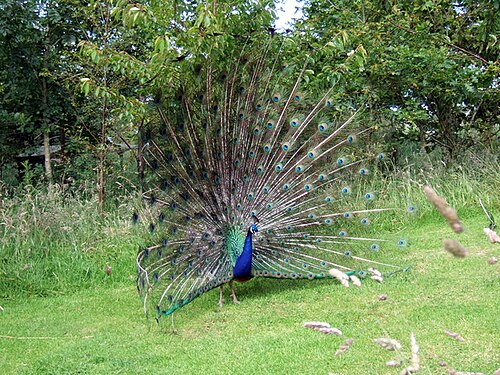
During the breeding season, a peacock works hard to impress peahens with his train display. He fans his feathers into a massive, quivering semicircle and turns slowly so the light catches every eyespot, while making a loud rattling sound by shaking the feathers rapidly. Scientists have found that peahens tend to prefer males with larger, more symmetrical trains that have the most eyespots. The low-frequency vibrations created by the shaking train may also play a role, as peahens can detect these vibrations through the ground and through the air. Peacocks are polygynous, meaning one male may mate with several females in a single season, but he does not help raise the young.
Peachicks and Family
After mating, the peahen finds a hidden spot on the ground — often under thick bushes or tall grass — and scrapes out a shallow nest. She lays between four and eight eggs and incubates them for about 28 days, relying on her camouflaged brown feathers to stay hidden from predators. When the chicks, called peachicks, hatch, they are covered in yellowish-brown down and can walk and feed themselves within hours. The peahen leads her brood around for several months, teaching them what to eat and warning them of danger with sharp alarm calls. Young males begin to grow their first short trains at about two years old, but they do not develop a full, magnificent display until they are three or four.
Peafowl and People
Peafowl have fascinated people for thousands of years. In ancient India and Greece, they were considered sacred or royal birds, and their feathers decorated thrones, temples, and crowns. Indian peafowl are protected by law in India, where harming one can result in fines or jail time. Today, peafowl are kept on farms, in zoos, and on private estates around the world, and breeders have developed color varieties including all-white, black-shouldered, and pied. While Indian peafowl are thriving globally, the green peafowl is classified as endangered by the International Union for Conservation of Nature, with fewer than 20,000 adults remaining in the wild due to hunting and habitat destruction.
Conservation
Protecting peafowl means protecting the forests and grasslands where they live. In India, wildlife reserves and national parks provide safe habitat for Indian peafowl, and the bird’s cultural importance helps keep public support strong. Green peafowl conservation is more urgent — organizations in Myanmar, Indonesia, and Vietnam are working to preserve remaining forest patches and reduce illegal hunting. The Congo peafowl is listed as vulnerable, and researchers are still learning basic facts about its behavior because the dense rainforest makes studying it extremely difficult. By supporting habitat conservation and responsible wildlife management, people can help ensure that all three species of peafowl continue to thrive in the wild.
 OtterKnow Kids Encyclopedia