What They Look Like
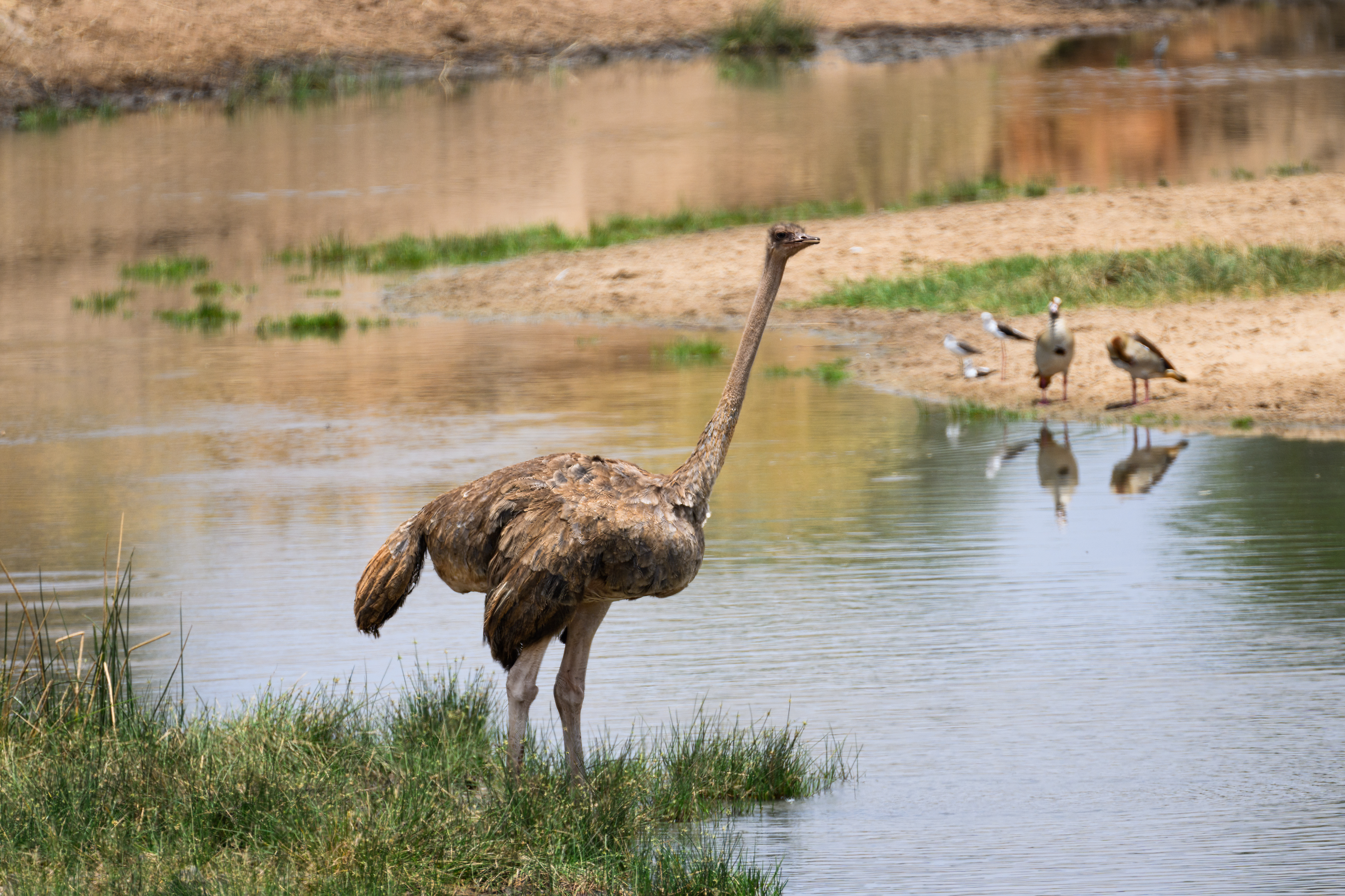
An adult male ostrich has striking black feathers covering most of its body, with white plumes on its wings and tail. Females and younger birds are covered in grayish-brown feathers that help them blend into the dusty landscape. Ostriches have the largest eyes of any land animal, measuring almost two inches across, which gives them excellent vision for spotting predators from far away. Their long, muscular legs are bare and end in just two toes on each foot, unlike most birds that have three or four. The inner toe has a large, sharp claw that can act almost like a hoof, giving the ostrich excellent grip and balance at high speeds and serving as a powerful weapon for self-defense.
Flightless but Fast
Ostriches belong to a group of flightless birds called ratites, which also includes emus and kiwis. Their wings are too small relative to their massive bodies to generate the lift needed for flight, and they lack the large breastbone that flying birds use to anchor their flight muscles. What ostriches lost in flying ability, however, they more than made up for in running speed. An ostrich can sprint at speeds up to 45 miles per hour (70 kilometers per hour), making it the fastest bird on land and faster than most horses. Each stride can cover up to 16 feet (5 meters), and they can maintain a steady pace of around 30 miles per hour for extended distances without tiring.
Where They Live
Ostriches are native to Africa, where they inhabit savannas, grasslands, and semi-arid desert regions. There are two living species of ostrich: the common ostrich found across much of sub-Saharan Africa, and the Somali ostrich which lives in the Horn of Africa region. They were once found across parts of the Middle East and Asia as well, but their range has shrunk significantly due to hunting and habitat loss. Today, wild ostriches are most commonly found in eastern and southern Africa. They prefer open landscapes where their height and sharp eyesight allow them to spot danger from a great distance. Ostriches are well adapted to hot, dry environments and can survive without drinking water for several days, getting moisture from the plants they eat.
What They Eat
Ostriches are omnivores, meaning they eat both plants and animals. Their diet consists mainly of seeds, shrubs, grasses, flowers, and roots, but they also snack on insects, lizards, snakes, and other small creatures they come across. Because ostriches do not have teeth, they swallow small stones and pebbles that sit in a muscular part of their stomach called the gizzard, which grinds up tough food. An adult ostrich may carry more than two pounds of stones in its gizzard at any given time. They are not picky eaters and will sometimes consume surprising items, which helps them survive in harsh environments where food can be scarce.
Eggs and Nesting
Ostrich eggs are the largest eggs laid by any living animal. Each egg measures about 15 centimeters (6 inches) long and weighs around 1.4 kilograms (about 3 pounds), which is roughly equal to 24 chicken eggs. Only dinosaurs are known to have produced larger eggs. A single egg has a shell so thick and strong that it can support the weight of an adult human standing on it. The dominant female, called the major hen, lays her eggs in a shared nest, which is simply a shallow pit scraped into the ground. Other females in the group may also add their eggs to the same nest, creating a communal clutch that can contain 40 to 60 eggs. The major hen and the dominant male take turns sitting on the eggs, with the female incubating during the day and the male at night, since his dark feathers provide better camouflage in the darkness.
Chicks and Family
Ostrich chicks hatch after about 42 days of incubation, emerging from their eggs already covered in spiky down feathers and ready to walk. Within just a few days, the chicks can keep up with the adults and begin following them across the landscape. The father ostrich plays a major role in raising the young, fiercely guarding them from predators like jackals, hyenas, and lions. A single forward kick from an adult ostrich is strong enough to injure large predators. Chicks from different families sometimes join together in large groups called creches, which can include dozens of young birds watched over by one or two adults. Ostriches grow quickly and reach their full adult size by about 18 months.
Social Behavior and Survival
Ostriches are social birds that typically live in small groups of about 10 to 12 individuals. During the dry season or when migrating, they sometimes gather into much larger flocks of 100 or more birds, often mixing with herds of grazing animals like zebras and antelopes. Living alongside these mammals benefits both sides: the ostriches’ sharp eyesight helps spot predators early, while the grazing animals stir up insects for the ostriches to eat. When they sense danger and running is not an option, ostriches sometimes lie flat on the ground with their necks outstretched, making their bodies look like a mound of earth from a distance. This behavior may be the source of the old myth that ostriches bury their heads in the sand.
Lifespan and Conservation
Wild ostriches typically live for 30 to 40 years, and those in zoos can live even longer, sometimes reaching 50 to 70 years of age. Humans have had a long relationship with ostriches stretching back thousands of years. Ancient Egyptians and Romans prized ostrich feathers for decoration, and ostrich eggs were used as water containers. Today, ostriches are farmed in many countries for their leather, meat, and feathers, which has reduced hunting pressure on wild populations. The common ostrich is currently listed as a species of Least Concern by the IUCN, but the Somali ostrich is classified as Vulnerable due to ongoing habitat loss and hunting.
 OtterKnow Kids Encyclopedia