What They Look Like
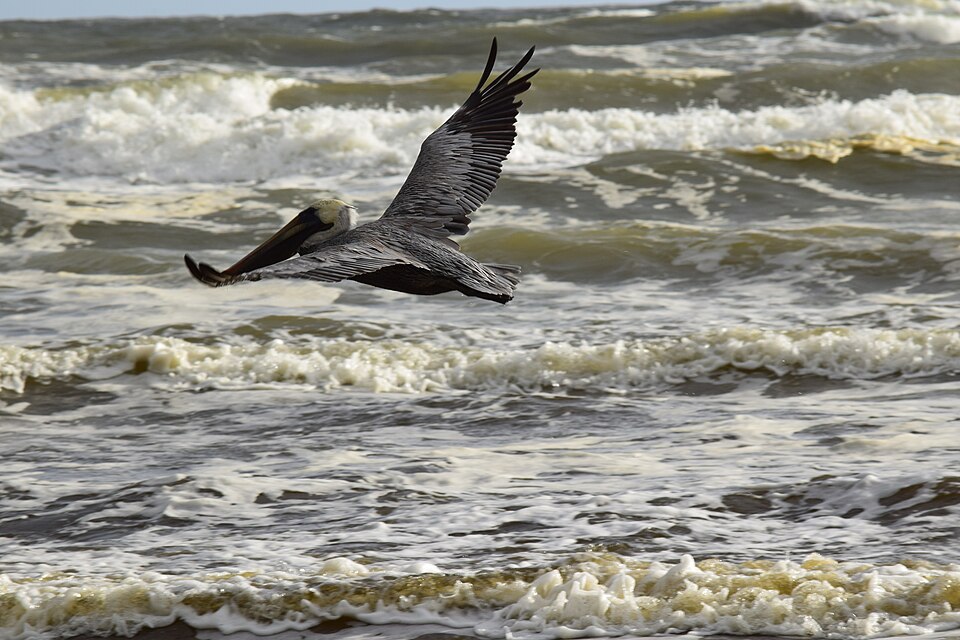
Adult brown pelicans stand about 4 feet tall and weigh between 6 and 12 pounds, with wingspans stretching up to 7.5 feet. Despite being called “brown,” their coloring is more complex than the name suggests. Adults have silvery-gray and brown feathers on their bodies, with white and yellowish coloring on their heads and necks. During breeding season, the back of the neck turns a rich dark brown, and a patch of bright red skin appears on the throat pouch. Young brown pelicans are mostly grayish-brown all over and gradually develop adult coloring over their first three years. Their most distinctive feature is the long bill with a flexible throat pouch that can hold up to three gallons of water.
Plunge-Diving
Brown pelicans are the only pelican species that hunts by plunge-diving, and watching them fish is one of the most exciting sights along the coast. A hunting pelican flies 20 to 60 feet above the water, scanning for schools of fish below. When it spots its target, it tucks its wings back and plunges headfirst into the water at speeds that can reach 40 miles per hour. Special air sacs under the skin of its chest act like airbags, cushioning the impact and helping the bird pop back to the surface. As the pelican hits the water, its pouch balloons open to scoop up fish and water. It then tips its bill downward to drain the water before swallowing the fish whole. Brown pelicans eat mainly small schooling fish like anchovies, sardines, herring, and mullet.
Where They Live
Brown pelicans live along the Atlantic and Pacific coasts of the Americas, from the mid-Atlantic states of the U.S. down through Central America and the Caribbean to northern South America. On the Pacific side, they range from southern California down to Peru and the Galapagos Islands. They prefer warm coastal waters and are rarely found far from the ocean. Brown pelicans roost on rocky shores, jetties, docks, sandbars, and even mangrove trees. Unlike their relative the American white pelican, which nests on inland lakes, brown pelicans stick close to saltwater throughout the year.
Breeding and Nesting
Brown pelicans are colonial nesters, gathering in groups of dozens to thousands of pairs on offshore islands or in mangrove forests. Males perform courtship displays by swaying their heads, showing off their colorful throat pouches, and presenting nesting materials to females. Once paired, both parents build the nest together, using sticks, reeds, and grasses. The female lays two to three chalky white eggs, and both parents take turns incubating them for about 30 days. Chicks hatch blind and featherless, relying entirely on their parents for food. The adults regurgitate partially digested fish directly into the nest for the chicks to eat. Young pelicans begin flying at about 11 to 12 weeks old.
DDT and Conservation
The brown pelican’s conservation story is one of the most dramatic in North American wildlife history. In the 1950s and 1960s, the pesticide DDT was widely sprayed to control mosquitoes and agricultural pests. DDT accumulated in the fish that pelicans ate and caused a devastating problem: the chemical made their eggshells so thin that they cracked under the weight of incubating parents. Brown pelican populations crashed across the Gulf Coast and California. By the early 1970s, the species had vanished entirely from Louisiana, its own state bird. The banning of DDT in 1972, combined with protections under the Endangered Species Act, allowed brown pelicans to slowly recover. By 2009, the species had rebounded enough to be removed from the endangered species list. Today, an estimated 300,000 brown pelicans live along the coasts of the Americas.
Brown Pelicans and People
Brown pelicans have a long relationship with people who live and work along the coast. Fishermen often see pelicans hovering near their boats, waiting for scraps or bycatch tossed overboard. The brown pelican is the state bird of Louisiana and appears on the state flag and seal. Despite their recovery from DDT, brown pelicans still face modern threats including oil spills, habitat loss from coastal development, entanglement in fishing line, and the effects of climate change on fish populations. Conservation groups continue to monitor nesting colonies, clean up coastal habitats, and rescue injured birds to help keep brown pelican populations healthy for future generations.
 OtterKnow Kids Encyclopedia