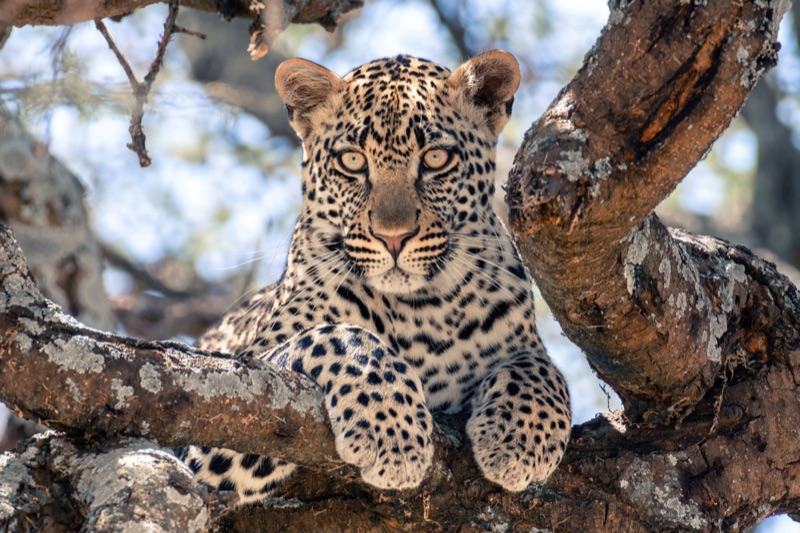
What They Look Like
Leopards have a muscular, compact body covered in golden-yellow fur marked with dark spots arranged in circular clusters called rosettes. Each leopard’s rosette pattern is unique, allowing researchers to tell individuals apart, much like a fingerprint. Their rosettes are different from the spots of a cheetah, which are solid black dots, and from the rosettes of a jaguar, which have a small dot in the center. Adult leopards typically weigh between 30 and 70 kilograms (66 to 154 pounds), with males being significantly larger than females. Some leopards are born with a condition called melanism, which turns their fur almost entirely black – these animals are often called black panthers, though they are the same species and their rosettes can still be seen faintly in bright light.
Climbing and Strength
Leopards are arguably the best climbers among all the big cats, and their unusual strength sets them apart from other predators. They have powerful shoulder and leg muscles that allow them to haul prey weighing as much as themselves up into the branches of tall trees. Leopards store their kills in trees to keep them safe from scavengers like hyenas and lions, which cannot climb as well. A leopard can carry a young antelope 9 meters (about 30 feet) straight up a tree trunk while gripping it in its jaws. Their retractable claws act like built-in climbing hooks, giving them a secure grip on bark and branches that few other animals can match.
Where They Live
Leopards have the widest range of any wild cat, living across sub-Saharan Africa, the Middle East, and large parts of Asia including India, China, and Southeast Asia. They are incredibly adaptable and can survive in tropical rainforests, dry savannas, mountain highlands, and even the edges of deserts. Some leopards have been spotted at elevations above 5,000 meters (16,400 feet) in the Himalayan foothills, though these high-altitude cats should not be confused with the snow leopard, which is a separate species. Leopards are one of the few large predators that can live close to human settlements, sometimes hunting in farmland and suburban areas at night without being noticed. This flexibility has helped them survive in places where other big cats have disappeared.
Hunting
Leopards are ambush predators that rely on stealth and patience rather than speed. They hunt mostly at night, using their excellent night vision and hearing to stalk prey in the darkness. A leopard will creep silently through the undergrowth, getting as close as possible before launching a short, explosive pounce. Their diet is remarkably varied and includes antelopes, monkeys, rodents, birds, fish, and even insects – scientists have recorded leopards eating over 100 different prey species. This ability to eat almost anything available is one of the key reasons leopards have survived in so many different habitats around the world.
Leopards vs. Jaguars
Leopards and jaguars look strikingly similar, but they live on entirely different continents and have several important differences. Jaguars are found only in the Americas, while leopards live in Africa and Asia, so the two species never meet in the wild. Jaguars are stockier and more heavily built, with larger heads and more powerful jaws that can crush turtle shells and crocodile skulls. The easiest way to tell their coats apart is to look closely at the rosettes: jaguar rosettes have small spots in their centers, while leopard rosettes are hollow. Jaguars also tend to prefer dense tropical forests near water, while leopards are comfortable in a much wider range of environments.
Solitary Life
Leopards are loners that spend most of their lives by themselves, coming together with other leopards only to mate. Each leopard maintains a territory that it marks with scratches on trees and scent markings to warn other leopards to stay away. A male’s territory can overlap with the territories of several females, but males avoid each other and will fight fiercely if one trespasses into another’s area. Leopards communicate through a distinctive rasping call that sounds like someone sawing wood, which carries well through dense forest. Despite their solitary nature, leopards have been observed occasionally tolerating the presence of a familiar neighbor at a shared water source during dry seasons.
Cubs and Family
Female leopards give birth to a litter of one to three cubs after a pregnancy of about 90 to 105 days. The mother hides her tiny cubs in dense vegetation, rock crevices, or hollow trees to protect them from predators like lions, hyenas, and even large eagles. Newborn cubs are blind and nearly helpless, weighing only about 500 grams (roughly one pound), and their fur is darker and woollier than an adult’s coat. The mother moves her cubs to a new hiding spot every few days to reduce the chances of a predator finding them by scent. Cubs begin following their mother on hunts at about three months old and stay with her for up to two years, gradually learning the skills they will need to survive on their own.
Conservation
The leopard is classified as Vulnerable by the International Union for Conservation of Nature (IUCN), with some subspecies in far more serious danger. The Amur leopard of eastern Russia and northern China is considered Critically Endangered, with fewer than 100 individuals remaining in the wild. Across their range, leopards face threats from habitat loss, poaching for their beautiful fur, and conflict with farmers who kill them to protect livestock. In parts of Africa, leopards are still legally hunted as trophies, though conservationists argue that this practice is difficult to manage sustainably. Protected areas, anti-poaching patrols, and programs that help farmers and leopards coexist are all playing important roles in ensuring leopards continue to roam the wild.
 OtterKnow Kids Encyclopedia