What They Look Like
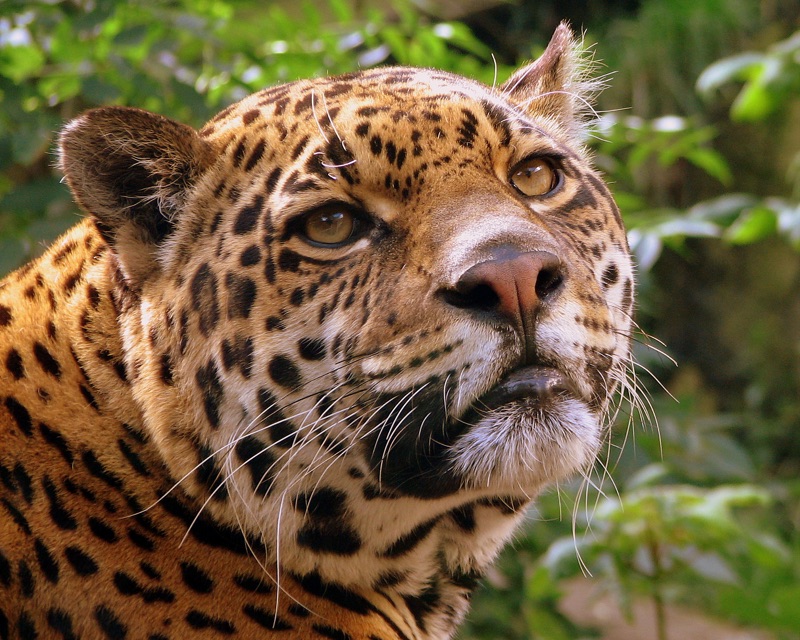
Jaguars have a golden-yellow coat covered with dark markings called rosettes. Unlike the rosettes on a leopard, a jaguar’s rosettes are larger and have small spots inside them, which is one of the easiest ways to tell the two cats apart. Some jaguars are born with so much dark pigment that they appear almost entirely black, and these individuals are often called black panthers, though their rosettes are still visible up close in the right light. Adult jaguars typically measure 1.1 to 1.9 meters (3.6 to 6.2 feet) in body length, with males weighing between 56 and 96 kilograms (123 to 212 pounds). Their heads are broad and rounded, with powerful jaw muscles that give them one of the strongest bites of any big cat.
The Most Powerful Bite
Of all the big cats in the world, the jaguar has the strongest bite relative to its body size. Their massive jaw muscles can generate a bite force of roughly 1,500 pounds per square inch, which is about twice as strong as a lion’s bite. This incredible jaw strength allows jaguars to do something no other big cat regularly does: bite directly through the skulls and shells of their prey. Jaguars can crack open the tough shells of river turtles and even pierce the thick skin and skull plates of caimans, which are relatives of alligators. Unlike lions and tigers, which usually kill prey by biting the throat to suffocate it, jaguars use a technique called a cranial bite — they drive their canine teeth directly through the skull of their prey, delivering a swift and powerful killing blow to the brain. The name “jaguar” itself comes from the Indigenous Tupí-Guaraní word yaguará, often translated as “beast that kills in a single bound.”
A Love of Water
While most cats avoid water, jaguars are excellent swimmers who actively seek out rivers, streams, and flooded forests. They spend considerable time in and around water, hunting for fish, turtles, and caimans along riverbanks and in shallow pools. During the wet season in the Amazon, vast stretches of forest flood for months at a time, and jaguars navigate this watery world with ease, swimming between partially submerged trees to stalk prey. Their comfort in water gives them access to food sources that other large predators cannot reach. This aquatic ability also makes them important regulators of river ecosystems.
Where They Live in the Rainforest
The jaguar’s primary home is the dense tropical rainforest of the Amazon Basin, the largest rainforest on Earth, which stretches across nine countries in South America. Brazil is home to more jaguars than any other country. They prefer areas near rivers, swamps, and wetlands where prey is plentiful and water is always close by. Although the Amazon is their stronghold, jaguars historically ranged from the southwestern United States all the way down to Argentina, but habitat loss has reduced their range to roughly half of what it once was.
What They Eat
As apex predators, jaguars have an impressively varied diet that includes more than 85 different species. They are ambush hunters that rely on stealth and surprise rather than long chases like the cheetah. They hunt large prey like white-lipped peccaries, capybaras, deer, and tapirs, but they are also skilled at catching smaller animals such as monkeys, birds, and armadillos. In the waterways of the Amazon, they ambush caimans and even catch anacondas, making them one of the few predators bold enough to take on giant snakes. They are also strong enough to drag prey several times their own weight up a tree or across a river. By preying on so many different species, jaguars prevent any single animal population from growing too large and damaging the forest.
Solitary Life
Jaguars are solitary animals that prefer to live and hunt alone. Each jaguar claims a home territory that it marks with scratch marks on trees and scent markings. A male’s territory can cover 50 to 100 square kilometers (19 to 39 square miles), while a female’s range is usually smaller. Males and females come together only briefly during mating season, and they communicate over long distances using deep, rumbling roars that echo through the forest. Outside of mating, jaguars avoid one another and will defend their territories fiercely against intruders of the same sex.
Cubs and Family
A mother jaguar gives birth to one to four cubs after a pregnancy of about 93 to 105 days. The cubs are born blind and completely dependent on their mother, who hides them in a sheltered den among thick vegetation or rocky crevices. Their eyes open after about two weeks, and they begin eating meat at around three months old. Young jaguars stay with their mother for up to two years, learning essential skills like hunting, swimming, and navigating the forest. Once they are ready to live on their own, the cubs leave to find their own territories, sometimes traveling hundreds of kilometers.
Cultural Significance
For thousands of years, the jaguar has held a place of deep reverence in the cultures of the Americas. The ancient Maya considered the jaguar a symbol of power, warfare, and the underworld, and Maya kings often took jaguar names or wore jaguar pelts to show their authority. The Aztecs had an elite class of warriors called the ocēlōmeh (jaguar warriors) who dressed in jaguar skins and were considered among the fiercest soldiers in the empire. In Amazonian Indigenous cultures that exist to this day, the jaguar is frequently seen as a spiritual guardian of the forest, and shamans are believed to have the ability to transform into jaguars. This deep cultural connection shows how the jaguar has shaped not only the ecology of the rainforest but also the imaginations and belief systems of the people who have lived alongside it for millennia.
Conservation
Despite their power, jaguars face serious threats in the modern world, and the species is currently listed as “Near Threatened” by the International Union for Conservation of Nature (IUCN). The greatest danger is deforestation — every year, enormous areas of the Amazon rainforest are cleared for cattle ranching, soybean farming, and logging, destroying the habitat jaguars depend on. As the forest shrinks, jaguars are forced into closer contact with humans and livestock, which often leads to conflict when jaguars prey on cattle and ranchers retaliate by killing them. Poaching for their skins and body parts is also a threat. Conservation organizations are working to protect jaguars by establishing wildlife corridors that connect isolated patches of forest, allowing jaguars to travel safely between habitats. Programs that help ranchers coexist with jaguars — by using better fencing, guard animals, and compensation for lost livestock — are also making a difference in reducing the number of jaguars killed each year.
 OtterKnow Kids Encyclopedia