What They Look Like
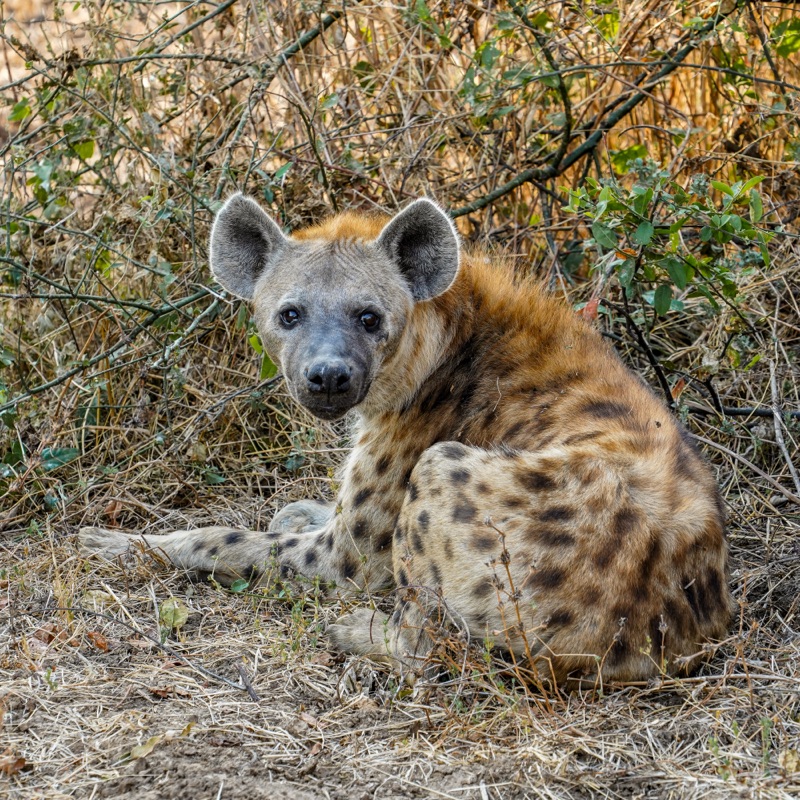
Spotted hyenas have a sturdy, muscular build with front legs that are longer than their back legs, giving them a distinctive sloping appearance from shoulder to tail. Their coarse, sandy-brown fur is covered in dark spots, which is how they got their name. An adult spotted hyena can weigh between 90 and 140 pounds, making it roughly the size of a large dog. They have broad, rounded ears and one of the most powerful jaws in the animal kingdom — strong enough to crush bone. Striped hyenas are smaller and shaggier, with vertical stripes on their legs and body, while the tiny aardwolf looks more like a small, insect-eating fox than a fierce predator.
Clans and Social Life
Spotted hyenas live in large social groups called clans, which can include up to 80 members. Unlike most mammal societies, spotted hyena clans are led by females, and every female in the clan ranks higher than every male. The highest-ranking female, called the matriarch, makes decisions about where the clan hunts and rests. Rank is passed down from mother to daughter, and cubs of high-ranking females get special privileges like first access to food. This female-led social structure is one of the most unusual in the entire animal kingdom and has fascinated scientists for decades.
Where They Live
Spotted hyenas are found across much of sub-Saharan Africa, from the open savannas of East Africa to woodlands and even mountainous regions up to 13,000 feet in elevation. They are incredibly adaptable and can survive in habitats ranging from semi-deserts to swampy areas, though they avoid true deserts and dense rainforests. Striped hyenas have a wider geographic range, living across North and East Africa, the Middle East, and into Central Asia and India. Brown hyenas are the rarest, found mainly in southern Africa along the coasts and dry interior. Each clan defends a territory that can stretch up to 400 square miles, and they mark the boundaries with a strong-smelling paste from scent glands.
Hunting and Scavenging
One of the biggest misconceptions about spotted hyenas is that they only eat leftovers from lions and leopards. In reality, spotted hyenas hunt between 60 and 95 percent of their own food, depending on the region. They are endurance hunters, chasing prey like wildebeest, zebras, and antelope over long distances at speeds of up to 37 miles per hour until the animal tires out. Hyenas often hunt in groups, working together to bring down animals much larger than themselves. Their powerful jaws and strong digestive systems allow them to consume nearly every part of their prey, including skin, hooves, and bones — very little goes to waste.
Communication
Hyenas are among the most vocal animals in Africa, using a wide range of sounds to communicate with their clan. Their famous “laugh” is actually a sign of nervousness or excitement, often heard when a hyena is being chased away from food by a more dominant clan member. They also whoop, growl, grunt, and squeal, with each sound carrying a specific meaning. A long, rising whoop can travel several miles across the savanna and helps scattered clan members find each other in the dark. Scientists have discovered that hyenas can recognize individual clan members by their calls alone, much like humans recognize each other’s voices.
Cubs and Family
Female spotted hyenas give birth to one or two cubs after a gestation period of about 110 days. Unlike many predator babies, hyena cubs are born with their eyes open and a full set of teeth, ready to compete with their siblings from birth. Cubs nurse for over a year, which is unusually long for a carnivore, and the mother’s milk is one of the richest of any land mammal. Young hyenas spend their early months in a communal den shared with cubs from other mothers in the clan, where they wrestle and play to establish their place in the social hierarchy. Males leave the clan when they are about two years old to join a new one, while females stay with their birth clan for life.
Hyenas in Myth and Reality
Throughout history, hyenas have gotten a bad reputation. Ancient stories from Africa, Asia, and Europe often portrayed them as cowardly thieves or even evil creatures. In modern movies and television, hyenas are frequently cast as villains or comic relief, reinforcing the idea that they are less noble than lions or cheetahs. The truth is that hyenas are remarkably intelligent — studies show they can solve problems and cooperate with each other as well as some primates can. Far from being simple scavengers, they are skilled hunters and devoted mothers that play a vital role in keeping African ecosystems healthy by recycling nutrients and controlling prey populations.
 OtterKnow Kids Encyclopedia