What They Look Like
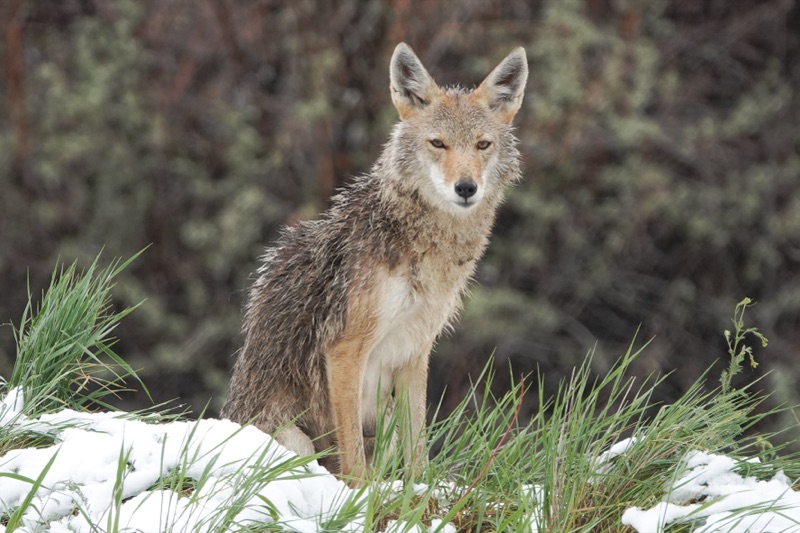
Coyotes look a bit like medium-sized dogs with pointed ears, a narrow snout, and bright yellow eyes. They typically weigh between 20 and 50 pounds, with males being slightly larger than females. Their thick fur is usually a mix of gray, tan, and brown on the back, with lighter cream or white fur on the belly and throat. A coyote’s bushy tail has a distinctive black tip and hangs low when the animal runs, which helps tell it apart from wolves, whose tails stay level or raised. Their large, triangular ears are excellent at picking up faint sounds, and their long legs allow them to sprint at speeds up to 40 miles per hour.
Where They Live
Coyotes are found across North America, from Panama in Central America all the way north to Alaska and Canada. They thrive in a wide variety of habitats, including deserts, grasslands, forests, mountains, and wetlands. As human cities have grown, coyotes have moved right in, making themselves at home in parks, golf courses, and even neighborhoods. Unlike wolves, which need large stretches of wilderness, coyotes are comfortable living close to people and can find food and shelter in surprisingly small patches of green space. Their ability to live in so many different environments is one of the main reasons their population has grown while many other predators have declined.
Communication and Howling
Few sounds in nature are as haunting as the howl of a coyote on a clear night. Coyotes use a rich vocabulary of howls, yips, barks, and growls to communicate with each other, and researchers have identified at least eleven different types of vocalizations. A group howl helps a family announce its territory to neighboring packs, warning them to stay away. Short, sharp barks serve as alarm calls when a coyote spots danger, while high-pitched yips are often used during playful interactions between pups. Coyotes also communicate through body language, using the position of their ears, tail, and fur to express emotions like dominance, submission, or fear.
What They Eat
Coyotes are true omnivores, meaning they eat both plants and animals depending on what is available. Their diet includes rabbits, mice, ground squirrels, insects, birds, snakes, and even deer when they hunt in pairs or small groups. In summer and fall, coyotes happily munch on berries, watermelons, and other fruits to round out their meals. City-dwelling coyotes have learned to scavenge from garbage cans, eat pet food left outdoors, and catch rats that live near human homes. This flexible diet is a major reason coyotes have been so successful — when one food source disappears, they simply switch to something else.
Family Life
Coyotes often form lifelong pair bonds, with a male and female staying together for many years and sometimes for their entire lives. Breeding season occurs in late winter, and after a pregnancy of about 63 days, the mother gives birth to a litter of five to seven pups in a cozy underground den. Both parents work together to raise their young, with the father bringing food to the mother while she nurses the pups. By the time they are about six months old, the pups begin learning to hunt by tagging along with their parents on foraging trips. Some young coyotes leave to find their own territories before their first birthday, while others stay with the family group for a year or more to help raise the next litter.
Coyotes and People
The relationship between coyotes and humans has always been complicated. Ranchers and farmers have long viewed coyotes as pests because they sometimes prey on livestock such as sheep and young calves. Despite more than a century of trapping, poisoning, and hunting programs aimed at reducing their numbers, coyote populations have actually increased and expanded. Many wildlife scientists now believe that heavy hunting can backfire because it breaks apart family groups and causes coyotes to have larger litters to compensate. In recent decades, attitudes have shifted as more people appreciate the role coyotes play in controlling rodent populations and maintaining healthy ecosystems.
Adaptability
The coyote may be the most adaptable large predator on the continent. When wolves were removed from much of North America during the 1800s and 1900s, coyotes moved into the ecological niches left behind and spread eastward across the entire continent. In the northeastern United States, coyotes even interbred with wolves and domestic dogs, producing a slightly larger hybrid sometimes called the “coywolf.” Urban coyotes have learned to look both ways before crossing busy streets and to adjust their schedules so they are most active at night when fewer people are around. Scientists studying coyotes in cities have found that they rarely bother humans and are actually quite shy despite living so close to us. The coyote’s ability to adapt to almost any situation means this clever canine is likely to thrive for a long time to come.
 OtterKnow Kids Encyclopedia