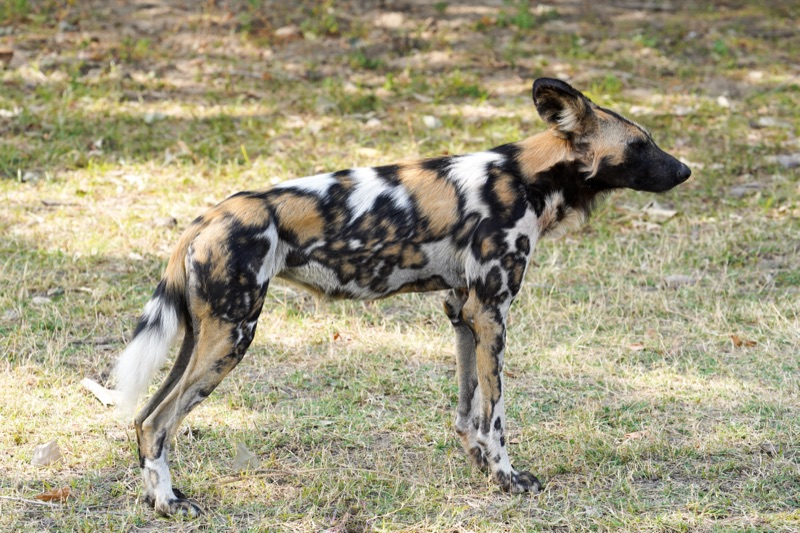
What They Look Like
African wild dogs are lean, long-legged animals built for endurance rather than brute strength. Adults typically stand about 60 to 75 centimeters (24 to 30 inches) tall at the shoulder and weigh between 20 and 30 kilograms (44 to 66 pounds), making them roughly the size of a medium-large domestic dog. No two African wild dogs have the same coat pattern, and scientists can use these unique markings to tell individuals apart, much like human fingerprints. Their large, rounded ears help them hear pack members over long distances and also release excess body heat, keeping them cool during daytime hunts. Unlike most other canids, African wild dogs have only four toes on each foot instead of five, which gives them a lighter, faster stride across the savanna.
Pack Life and Communication
African wild dogs are among the most social carnivores on Earth, living in packs that typically include 6 to 20 members led by an alpha male and alpha female. The pack operates with an unusual level of cooperation, with every member playing a role in hunting, guarding territory, and caring for the young. Before a hunt, the dogs perform an energetic greeting ceremony, jumping, licking, and making high-pitched twittering calls to rally the group and build excitement. They also communicate using a unique vocalization called a sneeze, which researchers have discovered works as a kind of vote: when enough pack members sneeze during a rally, the group decides to head out and hunt. This democratic decision-making sets African wild dogs apart from most other social predators, where a single dominant animal typically makes all the choices.
Where They Live
African wild dogs once roamed across nearly all of sub-Saharan Africa, from the edges of the Sahara Desert to the southern tip of the continent. Today, their range has shrunk dramatically, and they are found mainly in fragmented populations across eastern and southern Africa, with the largest numbers in countries like Botswana, Tanzania, Zimbabwe, and Mozambique. They prefer open grasslands, savannas, and sparse woodlands where their long-distance hunting style works best, avoiding dense forests where prey can easily escape through thick vegetation. Each pack needs an enormous home range of 400 to 1,500 square kilometers (150 to 580 square miles) to find enough food, which is why they come into frequent conflict with human settlements. Some of the healthiest populations live in large protected areas like the Selous Game Reserve in Tanzania and the Okavango Delta in Botswana.
Hunting
African wild dogs are the most successful large predators in Africa, with a hunt success rate of about 60 to 90 percent, far higher than lions at around 25 percent or leopards at roughly 38 percent. They hunt in coordinated packs, chasing prey at speeds of up to 60 kilometers per hour (37 miles per hour) over distances that can stretch for several kilometers. Their strategy relies on endurance rather than ambush: the pack takes turns leading the chase, wearing down the prey animal until it can no longer run. Their main targets are medium-sized antelopes like impala, kudu, and wildebeest calves, though a large pack can occasionally bring down animals as big as an adult zebra. After a kill, African wild dogs share food generously, allowing pups and weaker pack members to eat first, a behavior almost unheard of among other predators.
Raising Pups
Only the alpha pair in each pack usually breeds, and the rest of the pack helps raise the pups in an impressive display of cooperative parenting. The alpha female gives birth to a litter of 6 to 16 pups in an underground den, often an abandoned aardvark burrow, making it one of the largest litter sizes of any canid. For the first few weeks, the mother stays in the den while other pack members bring her food by swallowing chunks of meat and regurgitating it back at the den site. Once the pups are old enough to leave the den at about three months of age, the entire pack shares responsibility for feeding and protecting them. Pups practice hunting skills through play, chasing each other and pouncing on insects, and by one year of age they begin joining the pack on real hunts.
Threats and Conservation
African wild dogs face a long list of threats that have reduced their population to fewer than 7,000 individuals spread across only a fraction of their former range. Habitat loss is the biggest challenge, as farms and towns continue to expand into wild areas, breaking up the vast territories these dogs need to survive. They are also vulnerable to diseases like rabies and canine distemper, which can spread from domestic dogs to wild packs and wipe out entire groups in a matter of weeks. Competition with larger predators, especially lions and hyenas, further reduces their numbers, as these animals sometimes kill wild dogs or steal their food. Conservation programs in several African countries are working to protect wild dog habitat, vaccinate domestic dogs in surrounding communities, and create wildlife corridors that allow packs to travel safely between protected areas.
Why They Matter
African wild dogs play an important role in their ecosystems by helping to control populations of herbivores like antelope and keeping prey species healthy through natural selection. When wild dog populations decline, the animals they normally hunt can become overpopulated, which leads to overgrazing and damage to vegetation that many other species depend on. Their cooperative social structure also makes them an important subject for scientists studying animal behavior, communication, and the evolution of teamwork in nature. Protecting African wild dogs means preserving not just a single species but the balance of entire African ecosystems.
 OtterKnow Kids Encyclopedia