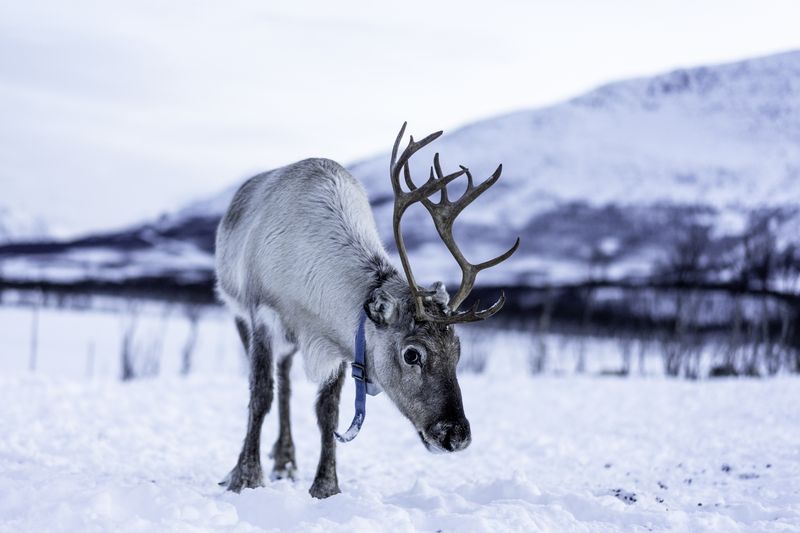
What They Look Like
Reindeer are medium-sized members of the deer family, standing about 3 to 5 feet tall at the shoulder. They have thick, double-layered fur that traps air close to their skin to keep them warm in temperatures that can drop far below zero. Their coat changes color with the seasons — darker brown in summer and lighter grayish-white in winter, which helps them blend in with their surroundings. Reindeer also have wide, crescent-shaped hooves that act like snowshoes, spreading their weight so they can walk on top of deep snow without sinking. Their hooves even make a clicking sound when they walk, caused by tendons sliding over bones in their feet.
Antlers
Reindeer are the only species of deer in which both males and females grow antlers. Male antlers can grow impressively large, sometimes spanning more than 4 feet from tip to tip, and they are used to compete with other males during the mating season each fall. Females grow smaller antlers, but they keep theirs through the winter while males shed theirs after mating season ends. This gives females an advantage when competing for food during the harsh winter months, since they can use their antlers to push other reindeer away from feeding spots. Antlers are made of bone and are among the fastest-growing tissues in the animal kingdom — a male reindeer can grow a full set in just a few months.
Where They Live
Reindeer and caribou are found across the Arctic and subarctic regions of the Northern Hemisphere, including Scandinavia, Russia, Mongolia, Greenland, Canada, and Alaska. They inhabit a range of cold environments, from open tundra where few trees grow to boreal forests filled with spruce and pine. During summer, many herds spread out across the tundra to take advantage of the long days and plentiful food. In winter, they often move into forested areas where the trees provide some shelter from biting winds and blizzards. Some populations also live on Arctic islands, where they have adapted to particularly extreme and isolated conditions.
Migration
Caribou are famous for undertaking some of the longest migrations of any land animal. Certain herds in Canada and Alaska travel more than 3,000 miles round trip each year, moving between their winter feeding grounds in the forests and their summer calving grounds on the open tundra. They travel in massive groups that can number in the tens of thousands, crossing rivers, mountains, and vast stretches of frozen ground along the way. These migrations are driven by the search for food and the need to reach safe places where calves can be born away from heavy predator pressure. Domesticated reindeer in Europe and Asia also move seasonally, though their routes are often guided by the herders who depend on them.
What They Eat
Reindeer are herbivores with a diet that shifts dramatically between seasons. During the brief Arctic summer, they feast on grasses, sedges, leaves, and wildflowers that sprout across the tundra. In winter, food becomes much harder to find, and reindeer rely heavily on lichens — slow-growing organisms that are sometimes called “reindeer moss.” They use their keen sense of smell to locate lichens buried under snow, then dig through the snowpack with their hooves to reach them. Reindeer have a specialized stomach with four chambers that helps them break down tough plant material, allowing them to extract as many nutrients as possible from their limited winter diet.
Reindeer and People
Reindeer have been closely tied to human cultures in the Arctic for thousands of years. Indigenous peoples such as the Sami of Scandinavia and the Nenets of Siberia have herded reindeer for centuries, relying on them for meat, milk, clothing, and transportation. Caribou are equally important to many Indigenous communities in North America, where they have been hunted sustainably as a vital source of food and materials for generations. In some parts of the world, reindeer are still used to pull sleds across snowy landscapes, a tradition that likely inspired the legend of Santa Claus and his flying reindeer. Today, reindeer herding remains a way of life for many Arctic communities, blending ancient traditions with modern challenges.
Conservation
While reindeer as a species are not currently endangered, many individual populations are declining and face serious threats. Climate change is one of the biggest concerns, because warming temperatures cause unusual freeze-thaw cycles that lock food under layers of ice, making it impossible for reindeer to dig through to the lichens below. Habitat loss from roads, pipelines, and industrial development also fragments migration routes and disturbs calving grounds. Some caribou herds in Canada have lost more than half their numbers in recent decades, leading conservation groups and governments to create protected areas and recovery plans. Scientists, Indigenous communities, and wildlife managers are working together to monitor herds and find solutions that protect both the animals and the people who depend on them.
 OtterKnow Kids Encyclopedia