What They Look Like
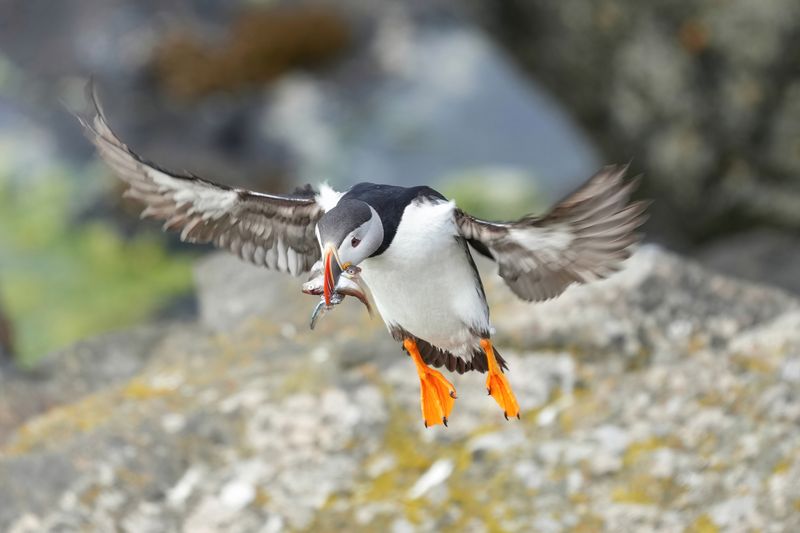
Puffins are stocky, medium-sized birds that stand about 25 centimeters (10 inches) tall, roughly the size of a small textbook stood on end. They have black feathers on their backs and wings, bright white bellies, and pale grayish-white cheeks. Their most striking feature is their large, triangular beak, which during the breeding season turns vivid shades of orange, red, and yellow with a slate-gray base. After the breeding season ends, the outer layers of the beak shed away, leaving it smaller and duller in color until the next spring. Puffins also have bright orange legs and feet, and their eyes are ringed with small, colorful patches that give them a slightly surprised expression.
Flying and Swimming
Puffins are unusual birds because they are excellent at both flying and swimming. In the air, they beat their short, stubby wings up to 400 times per minute, reaching speeds of around 88 kilometers per hour (55 miles per hour). Their small wings make takeoffs difficult, and puffins often have to run across the water’s surface while flapping furiously before they can get airborne. Underwater, puffins are even more impressive. They use their wings like flippers to “fly” through the ocean, steering with their webbed feet and diving to depths of up to 60 meters (200 feet) in search of fish. A typical dive lasts about 20 to 30 seconds, but puffins can hold their breath for over a minute when they need to chase fast-moving prey.
Where They Live
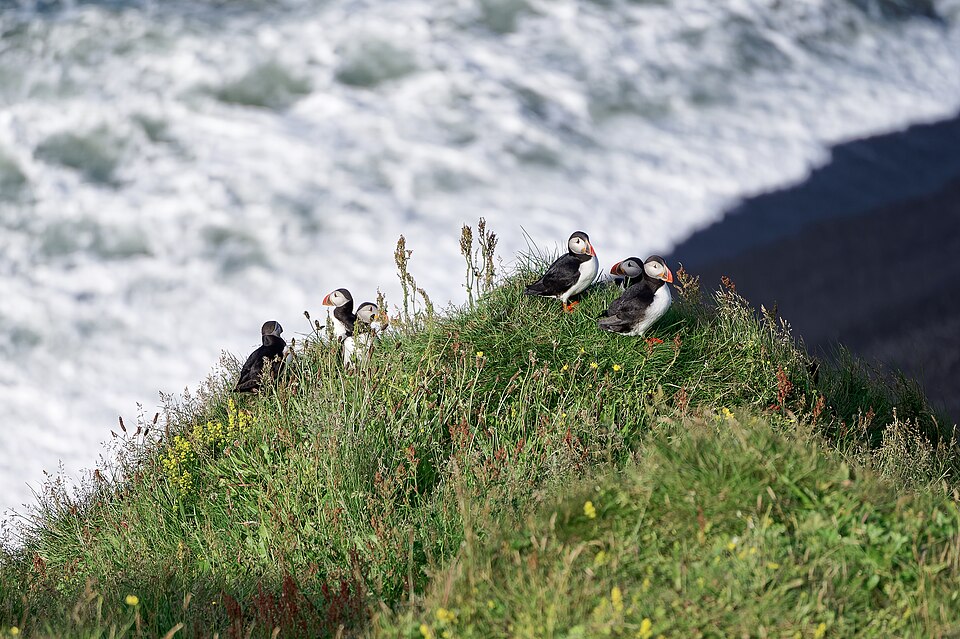
Atlantic puffins breed on rocky islands and sea cliffs along the coasts of Iceland, Norway, the United Kingdom, eastern Canada, and the northeastern United States. Iceland is home to the largest population, with several million puffins nesting there each summer. Horned puffins and tufted puffins breed along the coastlines of Alaska, British Columbia, and eastern Russia. Outside of the breeding season, puffins spend the entire winter far out at sea, bobbing on the open ocean and rarely coming close to shore. They are pelagic birds during these months, meaning they live entirely on the water, sleeping on the waves and feeding wherever the fish are plentiful.
What They Eat
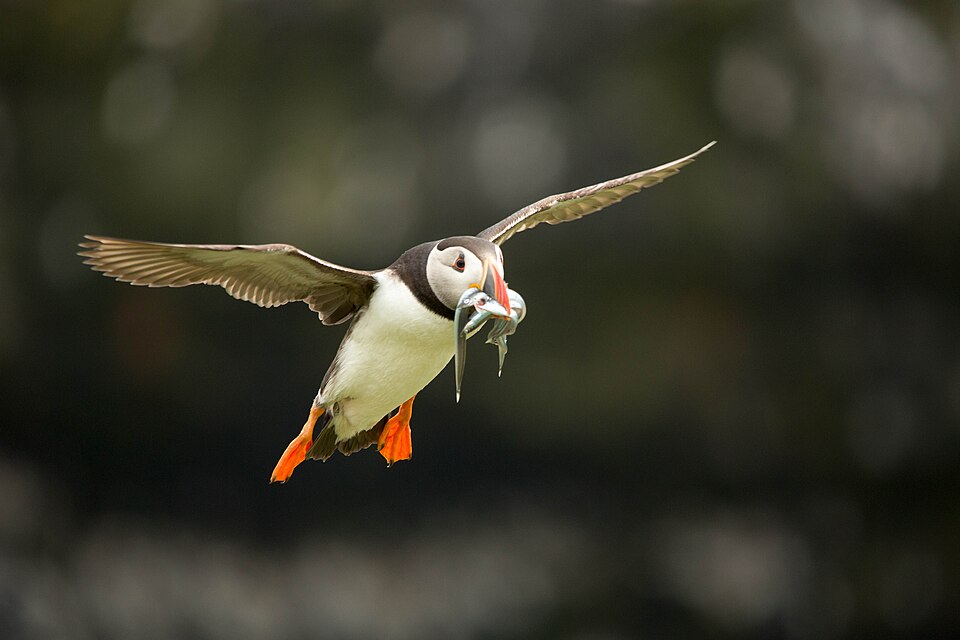
Puffins are carnivores that feed almost entirely on small fish. Their favorite prey includes sand eels, herring, capelin, and hake, depending on what is available in their part of the ocean. One of the puffin’s most unusual abilities is carrying multiple fish crosswise in its beak at the same time. Backward-facing spines on the roof of its mouth and a rough tongue help it grip fish already caught while opening its beak to snatch more. A single puffin has been recorded carrying over 60 small fish in its beak at once, though a load of 10 to 20 is more typical. This skill is especially important during the breeding season, when parents need to bring back as much food as possible for their hungry chick.
Burrows and Nesting
Unlike many seabirds that nest on open cliff ledges, puffins prefer to nest in underground burrows. They dig these burrows into soft, grassy soil on clifftops and hillsides using their sharp claws and strong beaks. A typical burrow is about 70 to 110 centimeters (2 to 3.5 feet) deep and curves at the end to create a small nesting chamber. Some puffins reuse the same burrow year after year, returning to the exact same spot each spring. In areas where the soil is too rocky for digging, puffins will nest in natural crevices between boulders instead. Puffin colonies can be enormous, with thousands or even hundreds of thousands of pairs nesting close together on the same island.
Raising Pufflings
Puffins usually mate with the same partner year after year, reuniting at their nesting burrow each spring. The female lays a single white egg, and both parents take turns keeping it warm for about 36 to 45 days until it hatches. The baby puffin, called a puffling, is covered in fluffy dark down and depends on its parents for all of its food. Both the mother and father make multiple fishing trips each day, bringing back beakfuls of small fish to feed the growing chick. After about six weeks, the puffling is fully feathered and ready to leave the burrow. It usually heads to the sea at night, when darkness helps protect it from predatory gulls, and it will spend the next two to three years living entirely at sea before returning to land for the first time to breed.
Conservation
Puffin populations face several serious threats in the modern world. Climate change is warming ocean waters, which shifts the distribution of the small fish that puffins depend on for food. In some areas, adult puffins are struggling to find enough fish close to their colonies to feed their chicks, leading to lower breeding success. Overfishing by humans also reduces the supply of sand eels and other prey species. Pollution, including oil spills and plastic waste, poses additional dangers to these ocean-dwelling birds. The Atlantic puffin is currently listed as Vulnerable by the International Union for Conservation of Nature (IUCN), meaning its population is declining and it could become endangered without conservation efforts. Organizations in Iceland, the United Kingdom, and North America are working to monitor puffin colonies, protect nesting habitats, and study how these birds are adapting to a changing ocean.
 OtterKnow Kids Encyclopedia