What They Look Like
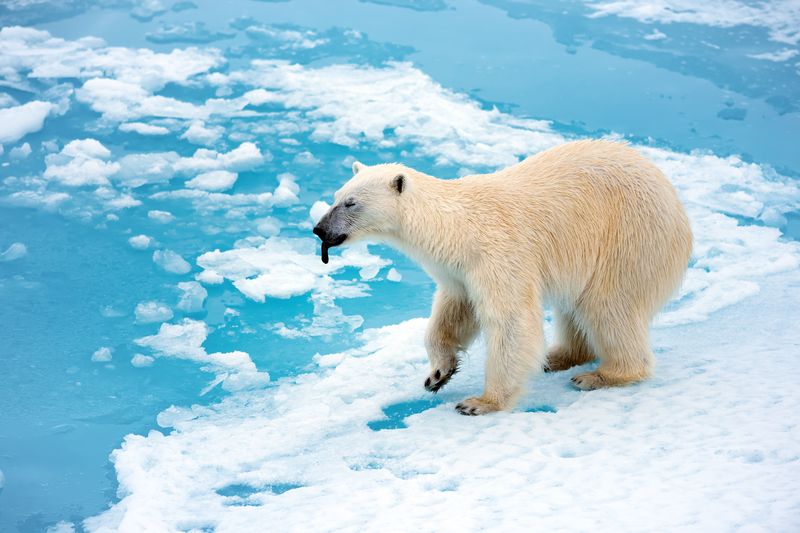
Polar bears are impressively large animals, with adult males standing about 2.4 to 3 meters (8 to 10 feet) tall on their hind legs and weighing between 350 and 700 kilograms (770 to 1,540 pounds). Females are significantly smaller, usually weighing about half as much as males. Their fur appears white or creamy yellow, but each individual hair is actually hollow and transparent, scattering light in a way that makes the coat look white. Underneath all that fur, a polar bear’s skin is jet black, which helps absorb heat from the sun. Their large, slightly webbed paws can measure up to 30 centimeters (12 inches) across, acting like snowshoes to spread their weight on thin ice and like paddles when swimming.
Staying Warm
Surviving in temperatures that can drop below negative 45 degrees Celsius (negative 50 degrees Fahrenheit) requires some special adaptations. Polar bears have two layers of fur: a dense, woolly undercoat that traps air for insulation, and longer guard hairs on top that repel water and keep the undercoat dry after a swim. Beneath their skin lies a layer of blubber up to 11 centimeters (about 4.3 inches) thick, which stores energy and provides additional insulation against the cold. Even their ears and tail are small and compact to minimize heat loss, a design that scientists call Allen’s rule. Together, these features keep polar bears so well-insulated that they sometimes overheat during physical activity and need to cool down by resting on the ice or taking a swim.
Where They Live

Polar bears roam the sea ice and coastlines of five Arctic nations: Canada, the United States (Alaska), Russia, Norway (Svalbard), and Denmark (Greenland). Canada is home to roughly two-thirds of the world’s polar bear population, which scientists estimate at about 22,000 to 31,000 individuals. These bears prefer areas where ocean currents and wind keep the ice in constant motion, creating gaps called leads and polynyas where seals come up to breathe. Polar bears are not territorial in the same way that many other predators are, and their home ranges can be enormous, sometimes spanning hundreds of thousands of square kilometers. During the summer, when sea ice melts in some regions, polar bears are forced onto land, where they fast or scavenge while waiting for the ice to return.
Hunting and Diet
Polar bears are patient and strategic hunters whose diet consists mainly of ringed seals and bearded seals. Their most common hunting technique is called still-hunting: a bear finds a seal’s breathing hole in the ice, then lies motionless beside it, sometimes for hours, waiting for a seal to surface for a breath of air. When the seal appears, the bear strikes with lightning speed, using its powerful forelimbs to haul the seal onto the ice. Polar bears can also stalk seals resting on ice floes, creeping forward on their bellies to get within striking distance. A polar bear’s sense of smell is extremely sharp, allowing it to detect a seal nearly a kilometer away or buried under a meter of snow. After a successful hunt, arctic foxes often trail behind to scavenge the leftovers.
A Life on the Ice
Polar bears are powerful swimmers that have been recorded covering distances of more than 680 kilometers (over 420 miles) in a single swim, paddling steadily for days at a time. They swim using their broad front paws for propulsion while their hind legs trail behind as rudders. On land and ice, polar bears usually walk at a slow, lumbering pace to conserve energy, but they can sprint at speeds up to 40 kilometers per hour (25 miles per hour) in short bursts. Despite spending so much time in the water, polar bears are classified as marine mammals, making them the only bear species with that distinction. Their daily lives revolve around the seasonal cycle of sea ice, traveling with the ice edge as it expands in winter and retreats in summer.
Cubs and Family
Female polar bears typically give birth for the first time between the ages of four and six, and they usually have two cubs at a time. In autumn, a pregnant female digs a maternity den in a snowdrift, often on a hillside near the coast, where she will rest without eating for several months. Cubs are born in December or January, tiny and helpless, weighing just over half a kilogram (about one pound). The mother nurses them in the den with milk that is extremely rich in fat, about 31 percent, allowing the cubs to grow rapidly. By the time the family emerges from the den in March or April, the cubs weigh around 10 to 15 kilograms (22 to 33 pounds) and are ready to follow their mother onto the sea ice. Young polar bears stay with their mother for about two and a half years, learning to hunt and survive before setting off on their own.
Predators and Dangers
Adult polar bears have no natural predators, sitting firmly at the top of the Arctic food chain. Cubs, however, are vulnerable to adult male polar bears, wolves, and occasionally orcas when swimming between ice floes. The most serious dangers to polar bears today come from human activities. Arctic sea ice has been declining steadily due to climate change, and less ice means fewer opportunities to hunt seals, the bears’ primary food source. Polar bears in some populations, such as those in Hudson Bay, Canada, are already showing signs of declining body weight and lower cub survival rates as the ice-free season grows longer. Pollution is another concern, as toxic chemicals from industry accumulate in the Arctic food web and concentrate in top predators like polar bears.
Conservation
The polar bear is classified as Vulnerable by the International Union for Conservation of Nature (IUCN), meaning it faces a high risk of extinction in the wild if current threats continue. In 1973, the five Arctic nations signed the International Agreement on the Conservation of Polar Bears, which regulates hunting and protects critical habitat. This agreement was one of the first major international treaties focused on a single species and has helped prevent overhunting. Today, the greatest challenge for polar bear conservation is slowing the loss of Arctic sea ice caused by rising global temperatures. Scientists project that if greenhouse gas emissions continue at current levels, two-thirds of the world’s polar bears could disappear by 2050. Protecting this iconic species depends on global efforts to address climate change and preserve the frozen habitat that polar bears need to survive.
 OtterKnow Kids Encyclopedia