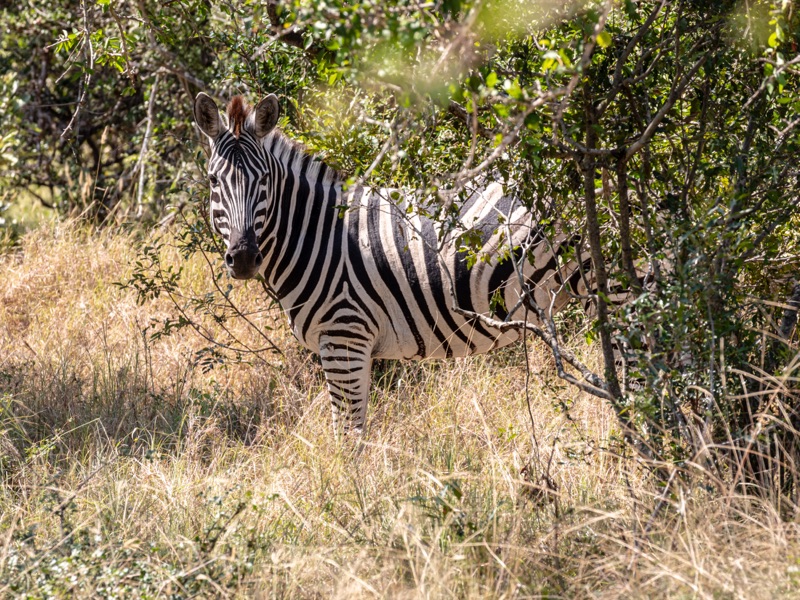
Three Species of Zebra
There are three living species of zebra, and each one looks a little different. The plains zebra is the most common and is found across the grasslands and savannas of eastern and southern Africa. It has broad stripes that are spaced relatively far apart, and some plains zebras show faint brownish “shadow stripes” between the main black stripes. The Grevy’s zebra is the largest of the three species, with a tall, slender body and narrow, closely spaced stripes. It lives in the dry scrublands of northern Kenya and southern Ethiopia. The mountain zebra is the smallest species and has a distinctive fold of skin called a dewlap on its throat. Mountain zebras are found in the rocky hills and highlands of Angola, Namibia, and South Africa.
Why Do Zebras Have Stripes?
Scientists have studied zebra stripes for more than a century, and several theories have been proposed. One of the most supported ideas is that the stripes confuse biting flies. Studies have shown that flies are less likely to land on striped surfaces than on solid-colored ones, which could help zebras avoid diseases carried by insects. Other researchers have suggested that stripes might help with temperature regulation, since black and white surfaces absorb heat differently. Another older theory is that stripes create a confusing visual effect when zebras run together, making it harder for predators to single out one animal from the herd. Whatever the full explanation, one thing is certain: every zebra’s stripe pattern is unique, just like a human fingerprint.
Habitat and Diet
Zebras are herbivores, meaning they eat only plants. Their diet consists mainly of grasses, though they will also eat leaves, bark, and shrubs when grass is scarce. Zebras have strong front teeth for clipping tough grass and flat back teeth for grinding it down. Because they can digest coarse, low-quality grasses that other grazers avoid, zebras often move into an area first and eat the taller, rougher grass, which then makes it easier for animals like gazelles and wildebeest to feed on the shorter, more nutritious grass beneath. This makes zebras important partners in the grazing cycle of the African savanna.
Herds and Social Life
Zebras are very social animals that live in groups. Plains zebras form small family units made up of one stallion, several mares, and their young. These family groups often join together to form larger herds of hundreds or even thousands of individuals. A group of zebras is sometimes called a dazzle. Family bonds among zebras are strong, and members groom each other by nibbling on one another’s manes and backs to remove pests and strengthen relationships. Grevy’s zebras are more loosely social and do not form the same tight family groups, though mares with foals often gather together for safety.
Predators and Defense
Zebras face threats from several powerful predators, including lions, hyenas, leopards, cheetahs, and wild dogs. When a predator approaches, zebras rely on their speed to escape, running at up to 65 kilometers per hour (about 40 miles per hour). They are also strong kickers and can deliver a powerful blow with their hind legs. Zebras in a herd take turns watching for danger while others eat or rest. If a predator gets too close, the stallion of a family group will often position himself between the threat and his mares and foals, giving them time to flee.
The Great Migration
Every year, around 300,000 plains zebras take part in one of the most spectacular wildlife events on Earth: the Great Migration across the Serengeti-Mara ecosystem in Tanzania and Kenya. Together with more than a million wildebeest and hundreds of thousands of gazelles, zebras travel a circular route of about 2,900 kilometers (1,800 miles) in search of fresh grazing land and water. The journey is dangerous, especially at river crossings where crocodiles wait. Zebras often lead the way during migration because they can eat the tall, tough grasses that wildebeest cannot.
Baby Zebras
A female zebra, called a mare, carries her baby for about 12 to 13 months before giving birth to a single foal. Newborn foals can stand and walk within minutes of being born, which is essential for keeping up with the herd and avoiding predators. A young foal’s stripes are often brown and white rather than black and white, and they darken as the foal grows. Foals stay close to their mothers for the first year or more, learning how to find food, recognize danger, and interact with the rest of the herd.
Conservation
The three zebra species face different levels of threat. Plains zebras are the most numerous, but their populations have declined due to habitat loss and competition with livestock. The IUCN lists the plains zebra as Near Threatened. Mountain zebras were once hunted nearly to extinction, but conservation efforts have helped their numbers recover, and they are now listed as Vulnerable. The Grevy’s zebra is the most endangered of the three, classified as Endangered by the IUCN. Its population dropped from around 15,000 in the 1970s to roughly 3,000 today, mainly because of habitat loss, competition for water with livestock, and poaching. Conservation programs in Kenya and Ethiopia are working to protect Grevy’s zebras through community-based efforts, habitat restoration, and anti-poaching patrols.
 OtterKnow Kids Encyclopedia